

It sounds reasonable. But the moment those words come out of your mouth in a police interrogation room, they can unravel a self-defence claim before you ever set foot in a courtroom.
One of the most persistent myths in Canadian criminal law is that self-defence is a simple, automatic right. It’s a kind of legal hall pass for anyone who throws the second punch. The reality, as any Edmonton defence lawyer will tell you, is far more complicated. Self-defence is a justification, not a right. It is a legal argument that must be carefully constructed, supported by evidence, and measured against an objective standard of reasonableness. All while a judge and jury scrutinize your every decision in the worst moment of your life.
Over the years practising in Edmonton and Northern Alberta courts, Rory Ziv has represented clients charged with everything from common assault to manslaughter. His clients were people who were genuinely frightened, genuinely defending themselves, and genuinely blindsided when police showed up at their door anyway. Understanding how Section 34 of the Criminal Code of Canada actually works, and where self-defence claims typically fall apart, can mean the difference between an acquittal and a conviction.
Section 34 of the Criminal Code: The Three-Part Test
When an Alberta court evaluates a self-defence claim, it applies a structured, three-part analysis rooted in Section 34 of the Criminal Code. All three elements must be present. A weakness in any one of them can, and often does, sink an otherwise credible defence.
Reasonable Apprehension of Force
The accused must have genuinely believed, on reasonable grounds, that force or a threat of force was being directed at them or another person.
Defensive Purpose
The accused’s purpose in responding must have been protection, not retaliation, not punishment, and not settling an old score.
Reasonable Response
The act committed must have been reasonable in all the circumstances. This is the most scrutinized and most often contested element in Alberta courts.
Courts apply both a subjective lens (what did you honestly believe?) and an objective lens (would a reasonable person in your exact position have acted the same way?). Meeting only one is not enough.
What the Courts Have Said: Key Decisions
R. v. Khill
This landmark ruling remains the leading authority on self-defence in Canada. The Court made clear that when evaluating whether a response was “reasonable,” the entire context matters, including whether the accused’s own prior conduct contributed to the escalation. If an individual helped create the confrontational situation, their ability to rely on Section 34 becomes significantly more difficult to establish. In practice, this means the court is not just asking what happened in that final moment, but what role the accused played in getting there.
R. v. Ryan
Though this case involved the doctrine of duress rather than self-defence directly, it reinforced a principle that applies with equal force here: the law does not demand that a person, in the grip of fear and adrenaline, calculate their response with clinical precision. Accused persons should not be penalized for failing to measure their reaction to the exact degree of necessity. That said, “I panicked” is not, on its own, a complete answer. The response still has to be reasonable.
Alberta-Specific Reasonableness Factors
Alberta appellate courts closely follow the enumerated factors in Section 34(2) when assessing proportionality. These include the physical characteristics of the parties involved (i.e., age, size, and gender), the history of any prior relationship between them, whether any weapons were present, and whether there was any opportunity to avoid the confrontation altogether. Local context matters, and so does local counsel who knows how these factors are weighed in Edmonton courtrooms.
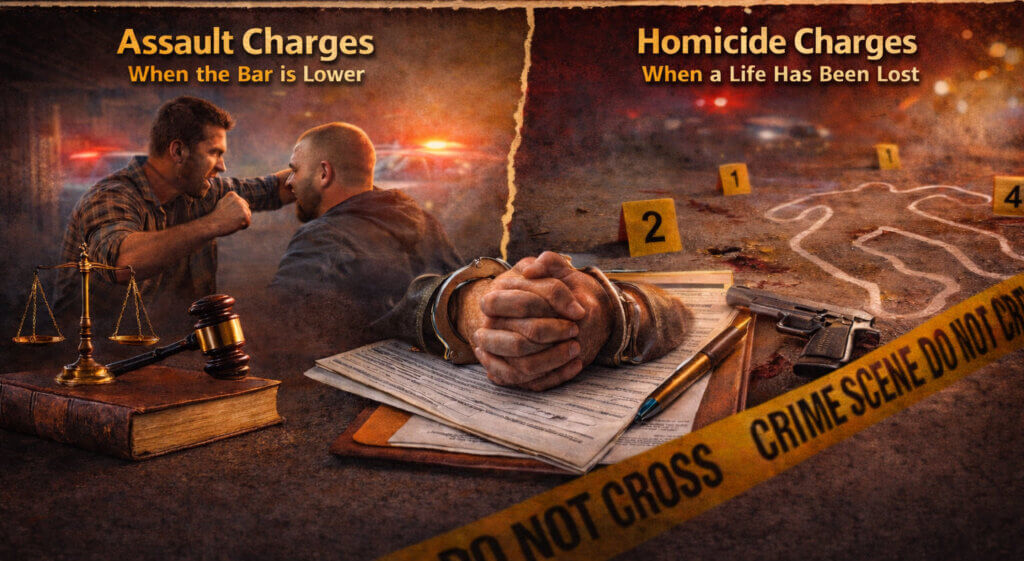
Assault vs. Homicide: The Stakes Change Everything
When the Bar is Lower
In straightforward assault cases, proportionality often turns on a fairly direct comparison: was the nature of the accused’s response roughly equivalent to the threat they faced? A push met with a push is one conversation. A punch met with a punch is another. The analysis is nuanced, but the scale of scrutiny is manageable with the right preparation.
When a Life Has Been Lost
When someone dies, the standard of “reasonable” becomes dramatically harder to meet. Courts will examine methodically whether deadly force was truly the only viable option in that moment. Before a jury can even weigh the self-defence argument, the court must first be satisfied that the claim clears the “Air of Reality” test: is there a genuine evidentiary basis for the defence, or is it speculative?
A self-defence claim in a homicide case is not simply a louder version of one in an assault trial. It requires a fundamentally different level of preparation, evidence gathering, and legal strategy. If you are facing homicide charges or serious assault charges in Edmonton, the time to contact a lawyer was yesterday.
What Alberta Courts Will Examine
Section 34(2) directs courts to consider all circumstances. In practice, here is what gets looked at:
- The nature of the threat: Was it imminent, credible, and serious?
- Whether the other party was armed, and the type of weapon involved.
- Whether the accused introduced or used a weapon and whether doing so was proportionate.
- The relative size, age, strength, and gender of everyone involved.
- Any prior history between the parties, including past violence or threats.
- Whether there was a reasonable opportunity to disengage or withdraw. Canada has no strict “duty to retreat,” but the absence of any attempt to withdraw is a factor in the reasonableness analysis.
- Whether the accused had any prior involvement in the criminal justice system relating to the other person.
Why Self-Defence Claims Fail: Common Pitfalls
Retaliation Mistaken for Defence
Once the immediate threat is over, any continued use of force transforms from self-defence into criminal reprisal. The threat must be ongoing or imminent. Returning blows after your attacker has clearly stopped is one of the most common ways a self-defence claim collapses.
Disproportionate Force
Escalating the weaponry of a conflict, such as introducing a knife into what was a bare-handed altercation, almost always undermines the “reasonableness” argument. The question courts ask is not just “were you defending yourself?” but “did you use only as much force as the situation actually required?”
Talking to Police Without Counsel
Explaining your actions to investigators without a lawyer present is, statistically, one of the most damaging things an accused person can do. Statements given in good faith, or attempts to explain what really happened, are frequently used to challenge the reasonableness of a self-defence argument in court.
