

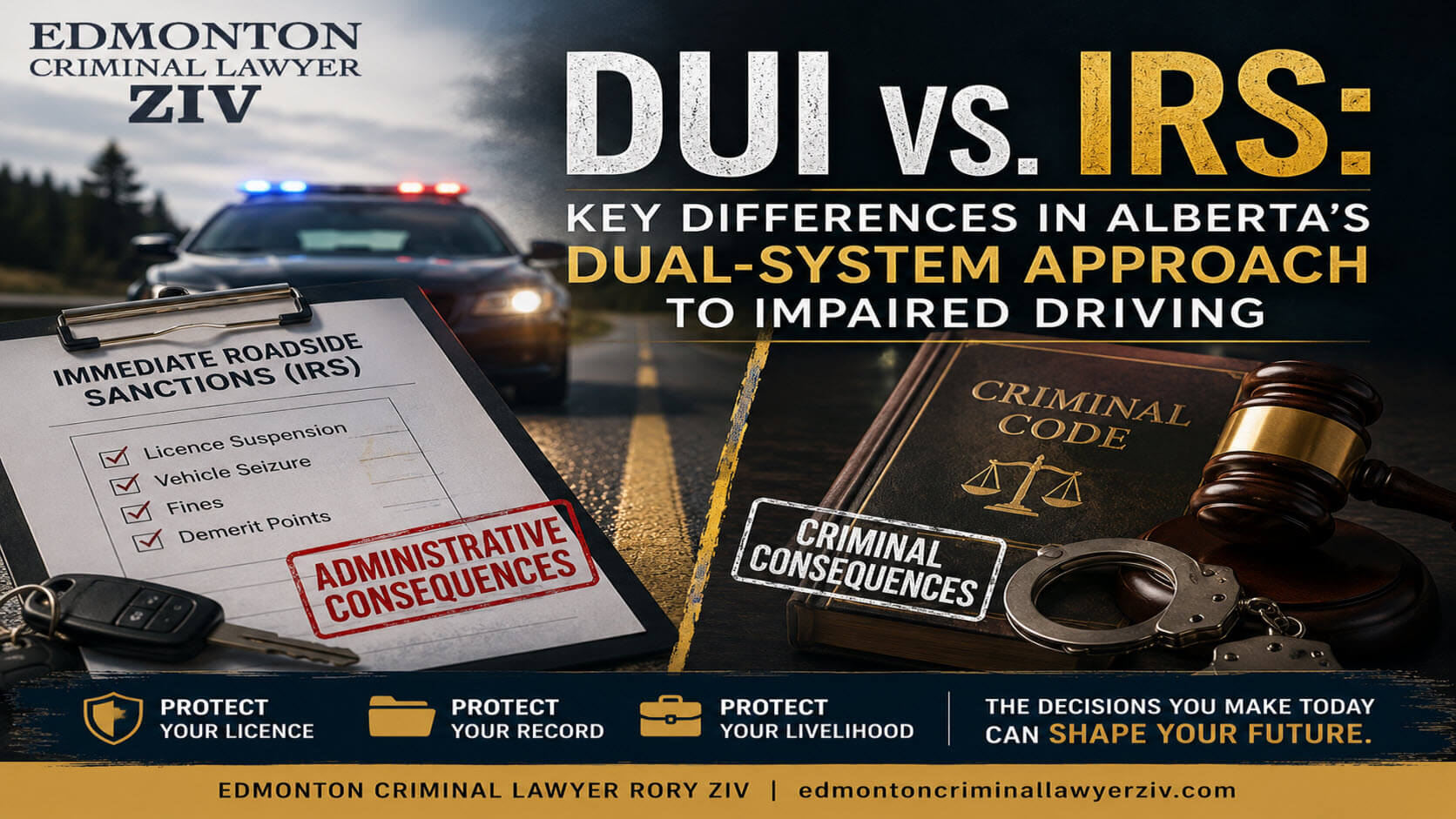
By Edmonton Criminal Lawyer Rory Ziv | edmontoncriminallawyerziv.com
Facing impaired driving consequences in Alberta? Whether you’ve received an Immediate Roadside Sanction or a criminal DUI charge, the decisions you make in the next few days can shape your future. Contact Edmonton criminal lawyer Rory Ziv today for a confidential consultation — protecting your licence, your record, and your livelihood starts now.
Alberta’s Two-Track Approach to Impaired Driving
If you’ve been stopped for suspected impaired driving in Alberta, you may be dealing with consequences under not one, but two entirely separate legal systems. Alberta is one of the few provinces that runs what’s often called a dual-system approach to impaired driving: an administrative track through the Immediate Roadside Sanctions (IRS) program, and a criminal track through Canada’s Criminal Code.
Understanding the difference between these two systems is not just academic; it’s essential. Each comes with its own rules, timelines, penalties, and appeal processes. And while IRS penalties may sound less serious because they aren’t criminal, they can still devastate your finances, your insurance rates, your employment prospects, and your ability to drive.
In this article, we will break down both systems clearly, explain how they interact, and outline why working with an experienced Alberta DUI lawyer can make a meaningful difference in your outcome.
What Are Immediate Roadside Sanctions (IRS)?
The Basics
Alberta’s Immediate Roadside Sanctions program was introduced in 2020 under the Traffic Safety Act as a way to handle most impaired driving situations quickly and administratively, without requiring a criminal court process in every case.
IRS penalties are imposed at the roadside by a police officer, not by a judge. They are considered administrative rather than criminal, meaning they do not result in a criminal record on their own. However, that doesn’t mean they are without serious consequences.
What Triggers IRS?
An officer can impose IRS penalties when a driver:
- Registers a blood alcohol concentration (BAC) of 0.05% or higher on an approved screening device
- Fails or refuses a roadside sobriety test
- Shows signs of drug impairment assessed through a Standard Field Sobriety Test (SFST) or Drug Recognition Evaluation (DRE)
- Registers any BAC reading as a Graduated Driver Licence (GDL) holder (zero tolerance applies)
IRS Penalty Levels
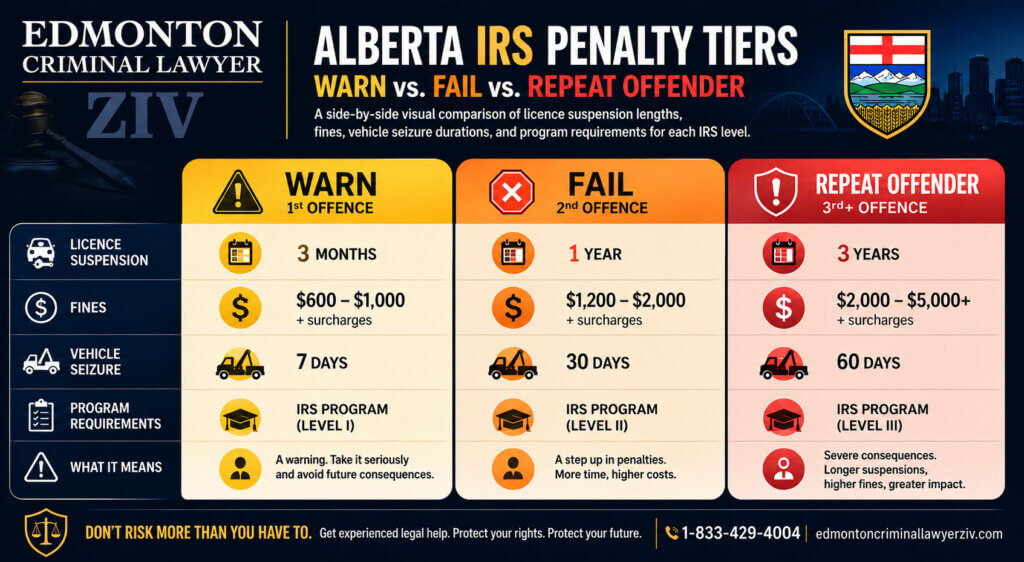
Alberta uses a tiered IRS structure based on severity:
IRS WARN (BAC 0.05–0.079%)
- Immediate 3-day licence suspension
- 3-day vehicle seizure
- $300 administrative penalty
IRS FAIL / Refusal / Drug Impairment (BAC 0.08%+ or drug impairment)
- Immediate 90-day licence suspension
- 3-day vehicle seizure
- $1,000 administrative penalty
- Mandatory enrolment in the Alberta Ignition Interlock Program (typically 12 months)
- Mandatory completion of an Impact Program (education/treatment)
Repeat Offences
Penalties escalate significantly for second and subsequent IRS violations within a 10-year period, including longer suspensions, higher fines, and extended interlock requirements.
Insurance Consequences of IRS
Even though IRS is administrative, your insurance company will typically be notified of your suspension. This can result in:
- Significant premium increases at renewal
- Loss of existing discounts
- Policy cancellation in some cases
- Being classified as a high-risk driver
What Are Criminal DUI Charges in Alberta?
The Criminal Code Framework
While IRS handles many impaired driving situations administratively, certain circumstances lead to criminal charges under the Criminal Code of Canada, specifically under sections 320.14 through 320.22.
Criminal impaired driving charges are pursued through the provincial court system and can result in a criminal record, jail time, and long-term consequences that extend well beyond a licence suspension.
When Are Criminal Charges More Likely?
Police and Crown prosecutors are more likely to pursue criminal charges when:
- A driver’s BAC is at or above 0.08% (the legal limit under the Criminal Code)
- A driver refuses or fails to comply with a demand for a breath or blood sample
- The impaired driving caused an accident with property damage, bodily harm, or death
- The driver has prior criminal convictions for impaired driving
- There is evidence of extreme impairment or a particularly dangerous situation
- The alleged incident involved dangerous driving in combination with impairment
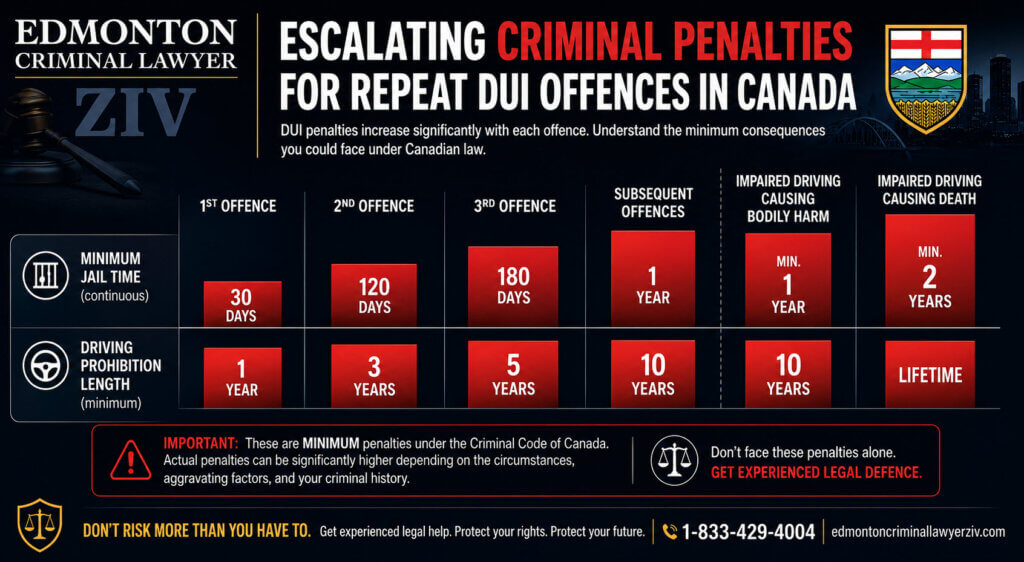
Potential Criminal Penalties
The consequences of a criminal DUI conviction are severe and long-lasting:
For a first offence:
- Minimum $1,000 fine
- Minimum 1-year driving prohibition (federally imposed)
- Criminal record
- Possible jail time (particularly if there were aggravating factors)
For a second offence:
- Minimum 30 days in jail
- Minimum 2-year driving prohibition
For a third or subsequent offence:
- Minimum 120 days in jail
- Minimum 3-year driving prohibition
Where bodily harm or death was involved:
- Potential imprisonment of up to 14 years (bodily harm) or life (death)
- These are among the most seriously prosecuted impaired driving cases in Canada
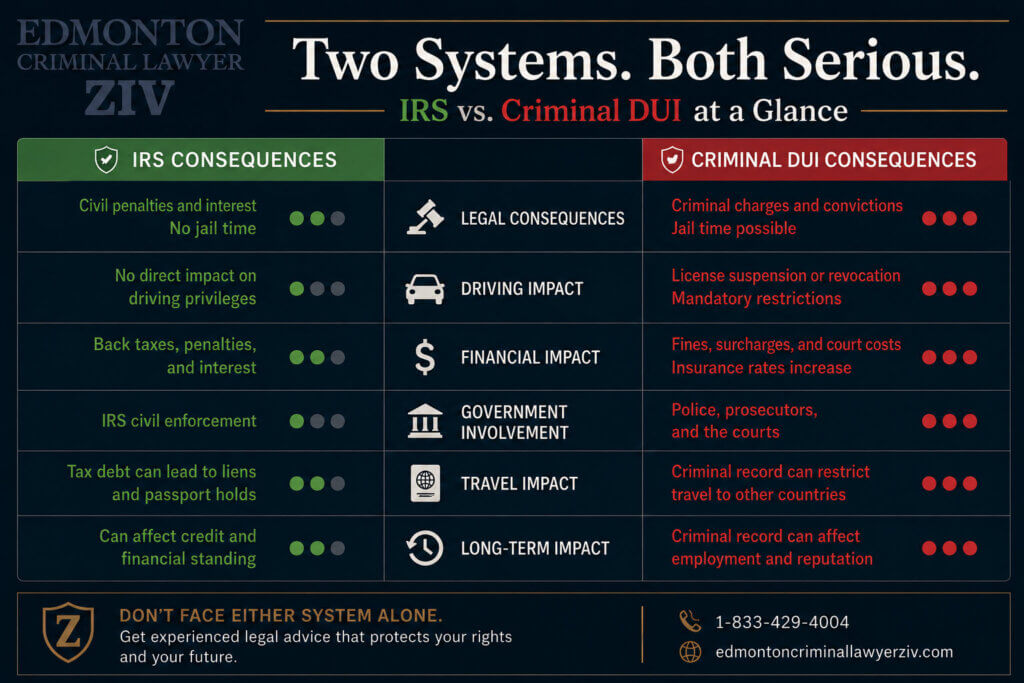
RS vs. Criminal DUI: A Detailed Comparison
The following table outlines the key differences between Alberta’s IRS administrative system and criminal DUI charges under the Criminal Code.
| Feature | IRS (Administrative) | Criminal DUI Charge |
| Nature of offence | Administrative / regulatory | Criminal offence under federal law |
| Who imposes the penalty | Police officer at roadside | Crown prosecutor / court |
| Where it is decided | Alberta Transportation (on review) | Provincial criminal court |
| Criminal record | No | Yes, if convicted |
| Court appearance required | Generally no | Yes |
| Licence suspension | Immediate, 3–90 days or more | Court-ordered, typically 1+ years |
| Jail risk | None | Yes — mandatory minimums for repeat offences |
| Fines | $300–$1,000+ administrative penalty | $1,000+ (minimum for first offence) |
| Vehicle seizure | 3 days (most cases) | Court may order longer |
| Ignition interlock | Mandatory for FAIL-level IRS | Mandatory post-conviction |
| Insurance impact | Significant increases likely | Severe, long-term increases |
| Employment consequences | Possible, depending on occupation | More serious; affects security clearances |
| International travel | Generally unaffected | Canada–US border crossing issues likely |
| Appeal rights | Alberta Transportation review process | Full criminal court defence rights |
| Legal defence options | Challenge officer’s procedures and evidence | Full criminal defence including Charter rights |
The Long-Term Consequences You May Not Have Considered
Many people underestimate how far-reaching impaired driving penalties, criminal or administrative, can be. Here are consequences that can follow you long after a suspension ends:
Insurance Premium Increases
An impaired driving event, even an IRS, can cause your auto insurance premiums to spike dramatically. Some drivers see increases of several hundred percent, and insurers may require placement in a high-risk pool for three to five years or longer following a criminal conviction.
Employment Concerns
Depending on your profession, an IRS or criminal DUI charge can have serious career implications:
- Regulated professions (nurses, teachers, engineers, social workers) may be required to self-report to their licensing bodies
- Commercial drivers face the potential loss of their commercial licence, ending careers in trucking, transit, or delivery
- Security clearance holders may have clearances revoked or denied following a criminal record
- Jobs requiring driving, from delivery to sales, may become inaccessible
Travel Restrictions
A criminal DUI conviction can significantly affect your ability to cross international borders:
- The United States treats impaired driving convictions as grounds to deny entry, even for Canadian citizens
- Some other countries also screen for criminal records at the border or during visa applications
Professional Licensing Issues
Many professional bodies in Alberta require their members to disclose criminal charges and convictions. A DUI conviction can lead to disciplinary proceedings, conditions on practice, or, in some cases, suspension of a professional licence.
Reputation and Personal Consequences
Beyond the formal penalties, the personal toll, stress, relationship strain, and reputational damage in the community, should not be underestimated.
How Edmonton Criminal Lawyer Rory Ziv Can Help
Regardless of whether you’re dealing with an IRS penalty or a criminal charge, having experienced legal representation in your corner matters. Here’s how Rory Ziv may be able to help:
Reviewing Police Procedures
Both IRS penalties and criminal charges depend heavily on whether police followed proper procedures. Issues such as how the roadside stop was conducted, whether approved screening devices were used correctly, and whether your rights were properly explained can all affect the validity of a penalty or charge. An experienced Edmonton DUI lawyer will scrutinize these details carefully.
Challenging IRS Penalties
Alberta’s IRS system includes a review process through Alberta Transportation. Challenging an IRS penalty requires meeting specific deadlines and understanding the evidentiary grounds for review. Rory Ziv can assess whether there are legitimate grounds for a challenge and help prepare a strong review request.
Defending Criminal DUI Charges
For criminal charges, the defence options are broader and include:
- Charter of Rights challenges, such as unlawful detention, improper demands for breath samples, or failure to provide access to legal counsel
- Challenging the accuracy or reliability of approved instrument readings
- Questioning witness evidence or the arresting officer’s observations
- Exploring alternative resolutions where the evidence and circumstances may support them
Minimizing Long-Term Impacts
Even when a penalty cannot be fully avoided, a lawyer can work to minimize the damage, whether by seeking reduced charges, arguing for more favourable sentencing, or guiding clients through mandatory programs in a way that supports their eventual return to full driving privileges.
Practical Strategies to Protect Yourself After an Impaired Driving Incident
If you’ve been stopped for impaired driving in Alberta, what you do next matters enormously. Here are lawful, practical steps:
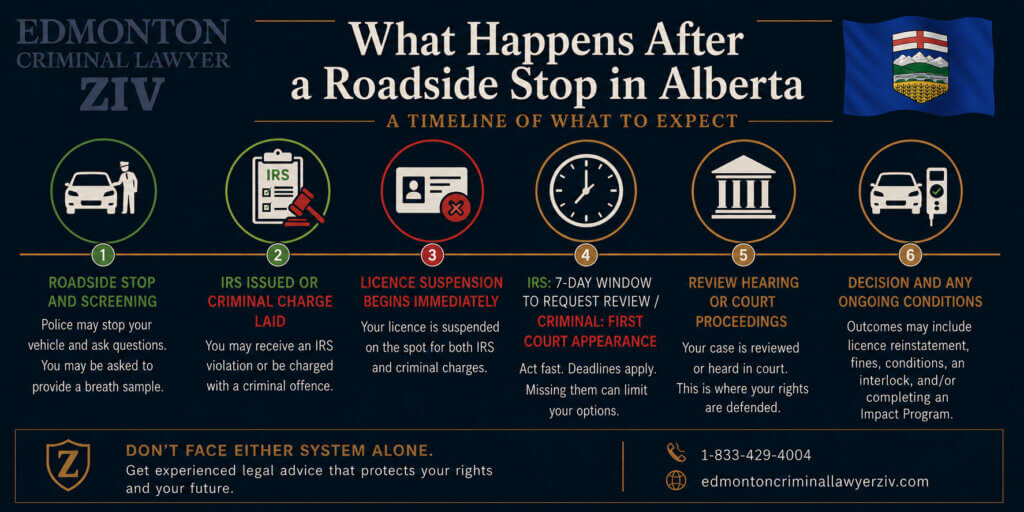
Act immediately. IRS review applications must typically be filed within 7 days of receiving the sanction. Missing this deadline can forfeit your right to challenge the penalty. For criminal matters, early action gives your lawyer the best opportunity to gather evidence and build a defence.
Do not delay seeking legal advice. Speaking with an Alberta DUI lawyer as soon as possible — ideally before taking any formal steps — gives you the best chance of understanding your options. Free or low-cost initial consultations are commonly available.
Gather your documentation. Keep all paperwork you received at the roadside: the Notice of Administrative Penalty, any notices of licence suspension, police contact information, and any receipts. Document your own recollection of events while it’s fresh.
Complete mandatory programs promptly. If an Impact Program or other condition has been imposed, completing it on time demonstrates good faith and can affect subsequent proceedings.
Avoid repeat incidents. A second IRS or criminal charge within a 10-year period carries dramatically escalating consequences. This is not the time to test fate.
Explore your defence options early. Defence evidence can disappear (dashcam footage gets overwritten, witnesses move on, memories fade). The sooner your lawyer begins the process, the stronger your defence can be.
Frequently Asked Questions
What is the difference between an IRS and a DUI in Alberta?
An IRS (Immediate Roadside Sanction) is an administrative penalty imposed by police at the roadside under Alberta’s Traffic Safety Act. A DUI (or criminal impaired driving charge) is a criminal offence under the Criminal Code of Canada. The key difference is that an IRS does not create a criminal record, while a criminal conviction does. However, both can have serious consequences for your licence, finances, and insurance.
Can an IRS lead to criminal charges?
Yes. In cases where a BAC reading is at or above 0.08%, where a driver refuses to comply with a demand, or where the impaired driving caused injury or property damage, police may lay both an IRS penalty and criminal charges. The two systems are not mutually exclusive.
Will an IRS show up on a criminal record check?
An IRS alone does not result in a criminal record. However, it will appear on your Alberta driver’s abstract, which insurers and some employers may access. A criminal conviction, by contrast, will appear on a criminal record check.
How much will my insurance go up after an IRS or DUI?
This varies significantly by insurer, your history, and the nature of the offence. An IRS can lead to premium increases of 25–100% or more. A criminal impaired driving conviction often results in dramatically higher increases, placement in a high-risk insurance pool, or even cancellation, for three to five years or longer.
How long will my licence be suspended?
For an IRS WARN-level, the immediate suspension is 3 days. For an IRS FAIL (or refusal/drug impairment), the immediate suspension is 90 days. For a first criminal DUI conviction, the federal driving prohibition is a minimum of 1 year. For repeat offences or more serious matters, suspensions are significantly longer.
Can a lawyer really help reduce an IRS penalty or fight a DUI charge?
Yes, in many cases. An IRS can be challenged through Alberta Transportation’s review process if there are grounds, such as procedural errors or equipment issues. A criminal charge provides even broader defence opportunities, including Charter challenges, expert evidence challenges, and more. Outcomes always depend on the specific facts of the case, but legal representation significantly improves your ability to navigate the system effectively.
I live outside Edmonton. Can Rory Ziv still help me?
Rory Ziv is an Edmonton-based criminal defence lawyer who handles cases throughout Alberta. If you’re dealing with an impaired driving matter anywhere in the province, contact the office to discuss your situation.
How quickly should I contact a lawyer after an IRS or criminal charge?
Immediately. The IRS review window is only 7 days. For criminal matters, earlier is always better since evidence is preserved, options remain open, and you avoid accidentally waiving rights or missing important steps. Don’t wait to see how things develop. Make the call now.
Alberta’s dual approach to impaired driving means that a single roadside stop can set two different legal processes in motion at once. Whether you’re dealing with an IRS administrative penalty, a criminal DUI charge, or both, the consequences can be serious — and they extend far beyond a temporary licence suspension.
Don’t Face DUI Charges in Alberta Alone
Protecting your driving privileges, your record, your career, and your future requires more than hoping for the best. It requires informed, experienced, and decisive legal action.
Edmonton criminal lawyer Rory Ziv has the knowledge and dedication to help Albertans facing impaired driving matters understand their options and fight for the best possible outcome. Contact the office today for a confidential consultation. The sooner you act, the more options you have.
Results depend on the specific facts and circumstances of each case. Nothing in this article constitutes legal advice or creates a solicitor-client relationship.
References
The following authoritative Canadian and Alberta sources were used to help us create the content of this article.
- Government of Alberta — Immediate Roadside Sanctions https://www.alberta.ca/immediate-roadside-sanctions
- Government of Alberta — Impaired Driving https://www.alberta.ca/impaired-driving
- Government of Alberta — Alberta Ignition Interlock Program https://www.alberta.ca/ignition-interlock-program
- Government of Alberta — Impact Program (Driver Education) https://ama.ab.ca/community/build/risky-driving/impaired-driving/aidrep/impact
- Criminal Code of Canada, R.S.C. 1985, c. C-46 — Part VIII.1 (Offences Relating to Conveyances) Sections 320.14–320.22 https://laws-lois.justice.gc.ca/eng/acts/C-46/
- Traffic Safety Act, R.S.A. 2000, c. T-6 (Alberta) https://www.qp.alberta.ca/documents/Acts/T06.pdf
- Alberta Transportation — Driver Fitness and Monitoring https://www.transportation.alberta.ca/content/doctype47/production/drvfitness.pdf
- Justice Canada — Impaired Driving Laws https://www.justice.gc.ca/eng/cj-jp/sidl-rlcfa/
- MADD Canada — Alberta Provincial Summary https://madd.ca/pages/
Note: All legal information in this article has been paraphrased from the above sources. Readers should consult the current versions of these documents and a qualified Alberta lawyer for the most up-to-date information applicable to their circumstances.