


The Hidden Weight of an Impaired Driving Record in Alberta
Receiving an impaired driving notice in Edmonton can be a jarring experience. One moment you are pulled over at a late-night checkstop or routine traffic stop, and the next moment your driver’s license is seized, your vehicle is loaded onto a tow truck, and you are left holding an administrative penalty form. In that moment of panic, most drivers focus entirely on the immediate inconvenience of getting home without a car. However, the long-term reality is far more serious. The true danger lies in how an allegation creates a lasting entry for impaired driving on your record.
In Alberta, impaired driving enforcement operates on a dual-track legal framework. The province utilizes administrative enforcement through SafeRoads Alberta alongside traditional criminal prosecutions under the Criminal Code of Canada. Many drivers mistakenly assume that if police do not take them to a police station in handcuffs, they have escaped without serious consequences. That assumption is a dangerous misconception. An administrative penalty under the Provincial Administrative Penalties Act creates immediate, long-lasting consequences for your driver’s abstract, insurance premiums, and employment prospects.
Knowing how an administrative sanction differs from a criminal conviction is crucial for protecting your future. We have created this guide to break down every stage of the process, from immediate roadside license suspensions to permanent national criminal databases. You will discover how records are created, how long entries remain visible, how commercial drivers are affected, and how experienced counsel at Ziv Law Group can challenge police errors to keep your record clear.

The Dual-Track Legal Framework: Administrative vs. Criminal DUI Enforcement
To understand how an allegation affects impaired driving on your record, you must first understand Alberta’s dual-track legal system. Prior to December 2020, almost all impaired driving stops in Alberta resulted in formal criminal charges that proceeded through the Provincial Court. Today, the province handles the vast majority of first-time and second-time impaired driving allegations through an administrative tribunal called SafeRoads Alberta.
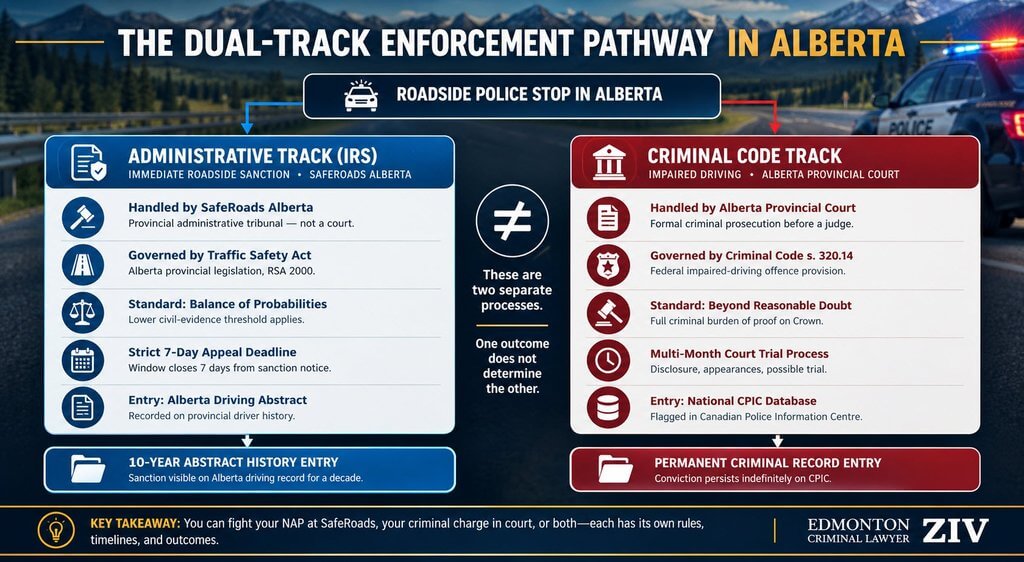
Under the administrative system, police officers act as both investigators and adjudicators at the curb. If an approved screening device registers a “Fail” (a blood alcohol concentration at or over 0.08) or if an officer believes a driver is impaired by drugs or alcohol, the officer issues an Immediate Roadside Sanction (IRS) Fail. This administrative pathway carries swift civil consequences, including:
- immediate license suspension,
- vehicle impoundment,
- heavy administrative fines, and
- mandatory education courses.
Conversely, the criminal track remains active for complex cases, repeat offences, or incidents involving bodily harm or death. When police lay formal charges under Section 320.14 of the Criminal Code of Canada, the matter proceeds through the criminal court system. Prosecutors must prove guilt beyond a reasonable doubt before a judge. While the administrative track targets your driving abstract, a criminal conviction creates a permanent national record that follows you across Canada and around the world.
Comparing Record Impacts: Driving Abstract vs. CPIC Criminal Database
A common source of confusion for drivers is the distinction between a commercial driving abstract and a national criminal record. Both records store information about impaired driving incidents, but they serve completely different purposes, are accessed by different authorities, and carry distinct long-term impacts.
Legal Callout: An administrative IRS penalty does not give you a criminal record on the Canadian Police Information Centre (CPIC) database. However, it creates a persistent entry on your Alberta driver’s abstract that insurance companies, employers, and registry agents view for up to ten years.
To clarify these differences, the comparison table below outlines how each record type handles entries for impaired driving on your record:
Comparison of Driving Abstract vs. CPIC Criminal Record
| Feature / Metric | Alberta Driving Abstract (Administrative IRS) | CPIC Criminal Record (Criminal Code Conviction) |
| Primary Governing Law | Traffic Safety Act & Provincial Administrative Penalties Act | Criminal Code of Canada (Section 320.14) |
| Record Database | Alberta Transportation / Registry System | Canadian Police Information Centre (CPIC) |
| Visibility Duration | Up to 10 years on commercial abstracts | Permanent (unless formal record suspension/pardon granted) |
| Who Can View It? | Auto insurers, employers, registry agents, police | Law enforcement, border officials, background check agencies |
| Impact on US Travel | Generally no automatic ban at land borders | High risk of border entry denial by US Customs |
| Auto Insurance Impact | Spikes premiums by 200% to 400% (High-Risk Facility Market) | Triggers policy cancellation or extreme high-risk rates |
| Primary Dispute Body | SafeRoads Alberta Tribunal (within 7 days) | Alberta Court of Justice / Court of King’s Bench |
Understanding this distinction highlights why defending against an administrative penalty is just as critical as fighting a criminal charge. Even without a formal criminal record, a ten-year entry on your driving abstract can destroy a commercial driving career and lead to tens of thousands of dollars in inflated insurance premiums.
The Anatomy of an IRS Fail Penalty: Penalties, Impoundments, and Interlock Rules
When an officer issues an IRS Fail penalty in Alberta, the consequences take effect instantly. There is no waiting period, no court date, and no automatic stay of enforcement while you decide what to do. The law presumes the administrative penalty is valid the moment the officer hands you the notice.
Alberta Immediate Roadside Sanction (IRS) Penalty Matrix
| Offence Category | Driving Prohibition | Vehicle Seizure | Administrative Fine | Interlock (Blow Box) Requirement | Educational Course |
| IRS Fail (1st Offence) | 90 days total ban + 12 months interlock | 30 days impoundment | $1,000 + 20% victim surcharge | Mandatory 12 months minimum | Planning Ahead course |
| IRS Fail (2nd Offence) | 90 days total ban + 36 months interlock | 30 days impoundment | $2,000 + 20% victim surcharge | Mandatory 36 months minimum | Impact course |
| IRS Fail (3rd Offence) | 90 days total ban + Lifetime interlock | 30 days impoundment | $3,000 + 20% victim surcharge | Mandatory lifetime (review at 10 yrs) | Impact course |
| IRS Warn (0.05 – 0.079) | 3 days suspension (1st offence) | 3 days impoundment | $300 fine | None (unless repeat occurrence) | None for 1st warn |
| IRS Zero Tolerance (GDL) | 30 days suspension | 7 days impoundment | $200 fine + 8 demerits | None | Mandatory reinstatement |
The Day-to-Day Reality of the Interlock “Blow Box” Program
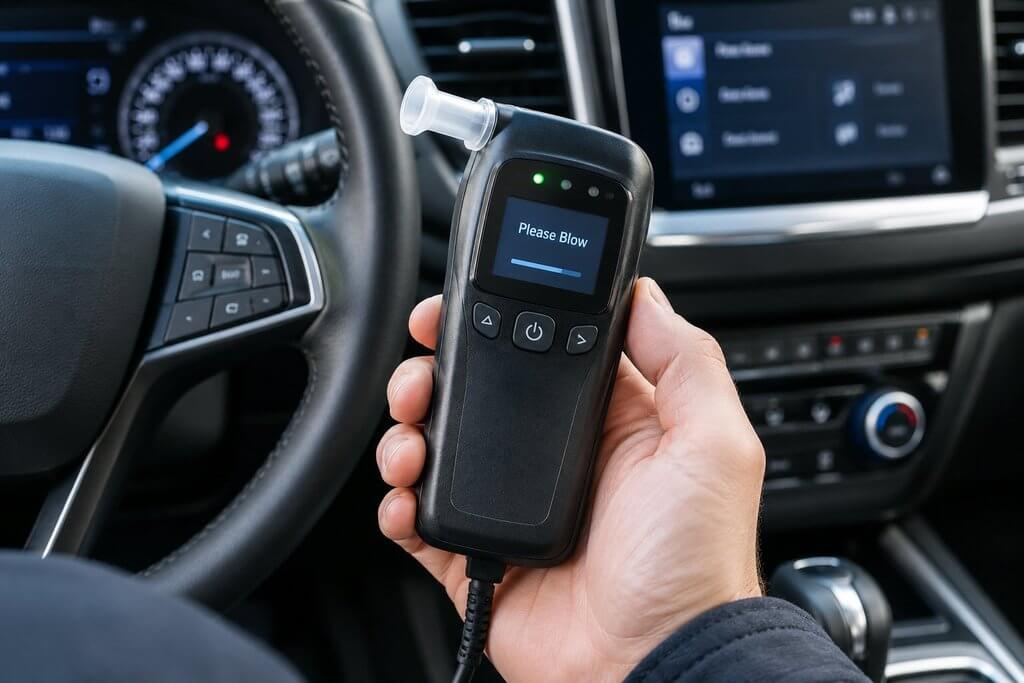
Following the initial 90-day absolute driving prohibition, drivers who wish to regain their license must enter the Alberta Ignition Interlock Program. An interlock device, commonly referred to as a “blow box,” is a hand-held breathalyzer wired directly into your vehicle’s ignition starter system.
Before the engine will start, you must blow an alcohol-free breath sample into the device. Once driving, the unit prompts you for periodic “rolling retests” at random intervals. If you fail a retest or miss a prompt, the device sounds an alarm, flashes lights, and logs a violation on its internal computer.
The financial burden of the interlock program is substantial. Drivers must pay out-of-pocket for every stage of the process, including:
- An installation fee ranging between $150 and $250
- A monthly monitoring and calibration rental fee of approximately $100 to $125
- An executive removal fee at the conclusion of the penalty period
- Application and registry reinstatement fees exceeding $100
If the computer log records a breath test failure or tampered wiring during monthly calibrations, SafeRoads Alberta can extend your interlock period for additional months. This mechanical oversight adds severe stress and financial strain to daily commuting.
Commercial Drivers at Risk: The Career-Ending Reality of Class 1 Penalties
For professional truck drivers, heavy equipment operators, delivery drivers, and emergency responders holding Class 1, Class 2, or Class 3 licenses, an administrative penalty can be a career-ending event. While a non-commercial driver might manage a temporary commute using transit or ride-sharing services, a commercial driver loses their ability to earn a living the exact moment an IRS notice is issued.
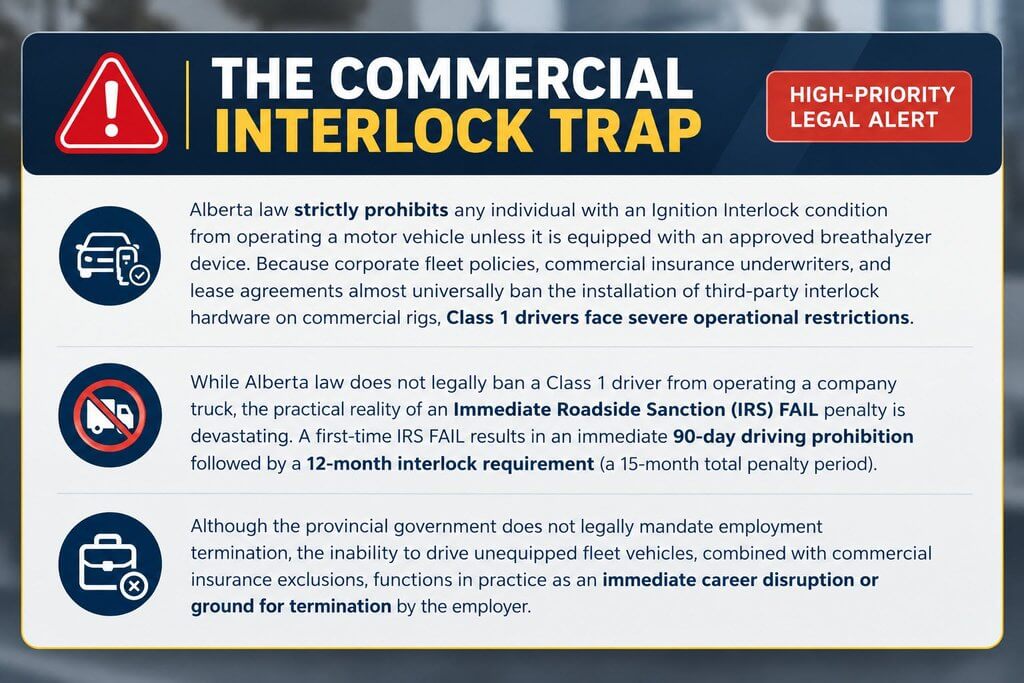
The Commercial Interlock Trap Explained
Consider a concrete scenario involving a Class 1 long-haul trucker based in Edmonton. The driver is stopped in his personal vehicle on a Saturday evening and receives an IRS Fail penalty. On Monday morning, his personal driving privileges are suspended.
Even after completing the mandatory 90-day absolute driving ban, he faces an insurmountable barrier:
- To drive legally, his license requires an interlock restriction.
- He cannot operate any vehicle lacking a blow box device.
- His employer operates a fleet of semi-trucks worth hundreds of thousands of dollars.
- The fleet owner’s corporate insurance provider refuses to permit interlock hardware installations on commercial vehicles.
- Result: The driver cannot operate his work truck, leading to immediate job termination, breach of commercial haulage contracts, and severe financial distress.
This reality explains why commercial operators cannot afford to accept an IRS penalty passively. Filing a timely appeal with SafeRoads Alberta or seeking an emergency statutory stay in the Court of King’s Bench is often the only way a professional driver can salvage their career and clear impaired driving on their record.
Collateral Consequences: Travel, Insurance Spikes, and Immigration Hazards
The damage caused by an impaired driving entry extends far beyond driver licensing and impound lots. The collateral fallout can disrupt your personal freedom, financial stability, and legal status in Canada for years to come.
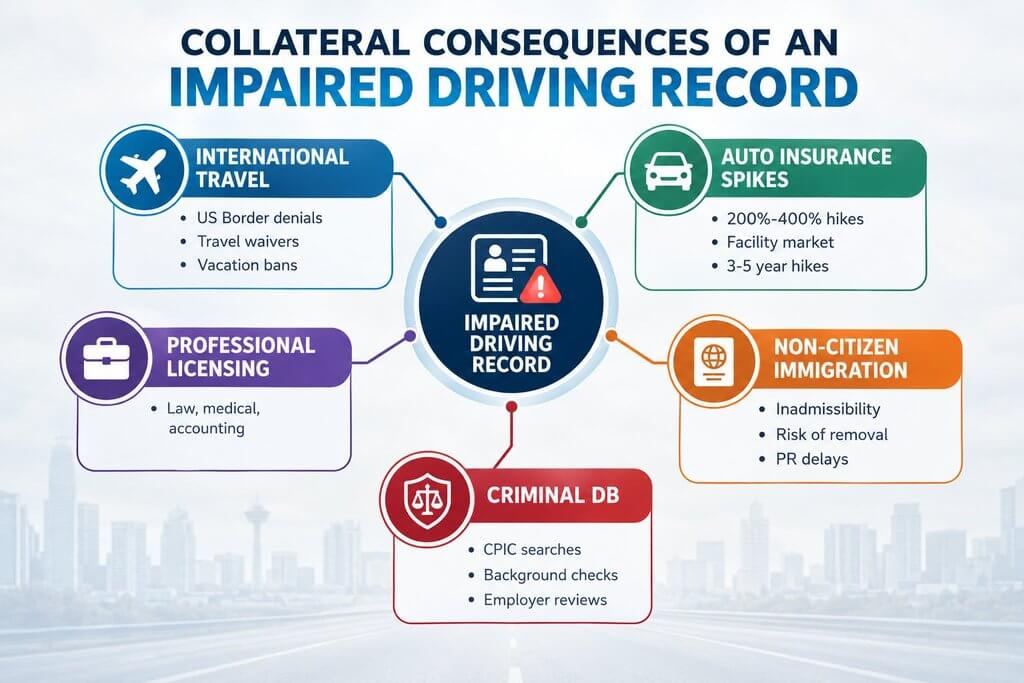
1. International Travel Restrictions (US Border Crossing)
While an administrative IRS penalty does not automatically appear on federal criminal databases, border agencies possess wide-ranging authority. United States Customs and Border Protection (CBP) officers at land crossings and international airports have direct access to Canadian criminal records via the U.S. National Crime Information Center (NCIC), which interfaces with Canada’s CPIC (Canadian Police Information Centre) database.
If border officials discover a history of multiple alcohol-related driving suspensions or a Criminal Code conviction, they have the statutory authority to deny you entry. While a standard, single DUI is not legally classified as a Crime Involving Moral Turpitude (CIMT) under U.S. law, a pattern of offenses or pending charges can lead officers to deem you inadmissible on grounds of a health-related disorder with associated harmful behaviour. Being turned back at the border results in missed vacations, cancelled business trips, and the costly requirement to apply for a formal U.S. Entry Waiver (Form I-192), which typically takes several months to process.
2. Auto Insurance Spikes: The High-Risk Facility Market
Insurance companies view any impaired driving entry as a critical risk factor. Following an Immediate Roadside Sanction (IRS) Fail or a criminal DUI conviction, standard insurance carriers will frequently cancel your non-mandatory coverage or transfer your profile to the high-risk Facility Association market.
- Standard Rates: Average annual premium of $1,500 to $2,500
- High-Risk Facility Rates: Annual premiums skyrocketing to $6,000, $8,000, or higher
- Duration: Insurance companies maintain these inflated high-risk surcharges for three to four years from the date of the infraction or conviction.
- Total Financial Cost: Over a four-to-five-year recovery period, an Alberta driver can easily pay an extra $20,000 to $30,000 in surplus insurance costs alone.
3. Immigration Hazards for Non-Citizens
Under federal immigration law, impaired driving under Section 320.14 of the Criminal Code carries a maximum potential sentence of ten years in prison. This statutory ceiling automatically classifies a criminal impaired driving conviction as a “serious criminality” offence under Section 36(1) of the Immigration and Refugee Protection Act (IRPA).
For Permanent Residents, foreign workers, and international students in Alberta, a criminal DUI conviction triggers immediate, severe consequences:
- Permanent Residents can instantly lose their status and face formal deportation proceedings with no right to appeal.
- Temporary workers and students face statutory inadmissibility, resulting in the denial of visa extensions, work permits, or PGWPs.
- Citizenship applications are placed on an immediate hold and will be rejected upon conviction.
The Administrative IRS Catch:
A first-time provincial Immediate Roadside Sanction (IRS) Fail is an administrative penalty rather than a criminal conviction. However, it can still create serious immigration concerns for non-citizens. When required, non-citizens must disclose the incident to Immigration, Refugees and Citizenship Canada (IRCC), particularly when asked about driving prohibitions or interactions with law enforcement.
Failing to disclose an IRS Fail properly can lead to a misrepresentation finding. That can result in a five-year ban from Canada. At the same time, the underlying driving record may receive additional scrutiny during an immigration application, including on broader public safety grounds.
Crucial Timelines: The Non-Negotiable 7-Day SafeRoads Appeal Clock
When facing an administrative driving penalty in Alberta, time is your most critical asset and your greatest risk. The single most common mistake drivers make is delaying action while researching their options or waiting for paperwork in the mail.
SafeRoads Appeal Timeline Breakdown
| Stage / Action | Path A: Acting Within the 7-Day Window | Path B: Missing the 7-Day Window |
| Appeal Filing | Formal dispute filed online within 7 calendar days ($150 fee) | Appeal portal locks automatically; right to review is lost |
| Police Disclosure | Full police report, breath calibration logs, and notes provided | No disclosure provided; police files remain unscrutinized |
| Review Hearing | Written or oral video hearing conducted within 21 days | No hearing scheduled; penalty stands permanently |
| Driving Abstract Entry | Penalty cancelled if successful; abstract entry removed completely | 10-year administrative entry locked onto driving record |
| Interlock Requirement | Waived completely if appeal is granted | Mandatory 12-month minimum interlock condition enforced |
| Last Resort Options | Emergency Court of King’s Bench Judicial Review available | Late appeal permitted only under extreme medical incapacitation |
Action Checklist: What to Do Within 48 Hours of an IRS Stop
- Preserve Every Document: Keep the blue Notice of Administrative Penalty form, the vehicle seizure record, and all towing invoices intact.
- Photograph Your Notice: Take a clear, well-lit smartphone photo of the front and back of your suspension notice.
- Calculate Your Deadline: Count exactly seven calendar days from the issue date printed on your notice. Weekends and statutory holidays count toward the seven days.
- Do Not Submit Personal Written Statements: Avoid drafting personal letters to SafeRoads explaining why you were driving. Self-represented drivers frequently make written admissions that destroy their defense.
- Contact Ziv Law Group Immediately: Send your notice photo to our Edmonton legal team at 587-415-5786 so we can secure emergency police disclosure and file your dispute before the portal closes.
Winning Strategies: How Rory Ziv and Ziv Law Group Challenge DUI Charges
Defending against an administrative driving penalty or a Criminal Code charge requires deep familiarity with breathalyzer mechanics, constitutional law, and police procedure. At Ziv Law Group, we do not rely on generic pleas for sympathy. SafeRoads adjudicators are legally barred from cancelling a penalty based on financial hardship, employment necessity, or personal inconvenience. To win, your defense must prove technical flaws, procedural errors, or Charter violations.
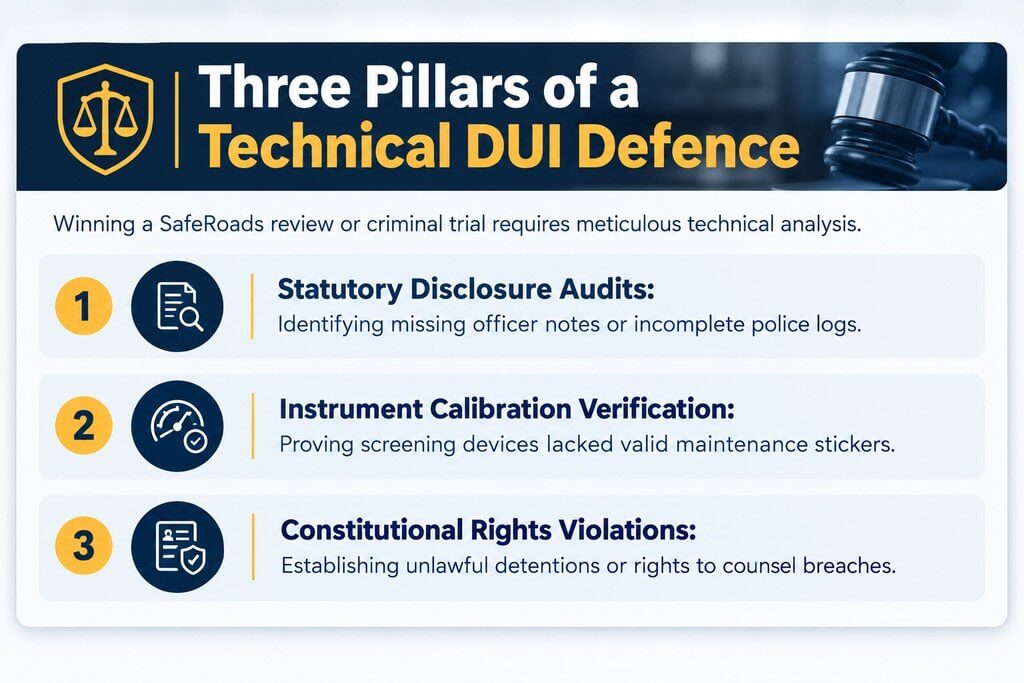
1. Auditing Mandatory Police Disclosure
Under Alberta’s SafeRoads regulations, police officers must upload specific evidentiary records to the portal within strict timelines. These records include detailed officer notes, narrative reports, breath testing logs, and vehicle stop records.
In key cases such as Russel v Director and Gordey v Director, courts confirmed that if police fail to provide required records or submit incomplete officer notes, the Director cannot meet the burden of proof. When our legal team identifies missing or contradictory disclosure records, we demand the immediate cancellation of the administrative penalty.
2. Challenging Instrument Calibrations and Maintenance Records (The Samuelson Precedent)
Approved screening devices and breathalyzer instruments require regular calibration using certified alcohol reference solutions, as well as annual maintenance. If a screening device is out of calibration or has missed its maintenance, its digital reading is scientifically unreliable.
Real-World Case Precedent (Samuelson (Re), 2022 ABSRA 1169): In this SafeRoads Alberta decision, the police photo of the approved screening device showed a service tag with a maintenance expiry date of January 27, 2022, and a calibration date of March 25, 2022. The roadside test took place on April 9, 2022. The device’s calibration was current, but its maintenance had expired more than two months earlier, and the police produced no records showing it was serviced after January 27. The adjudicator found that the device had not been annually maintained. That finding was enough on its own to cancel the Notice of Administrative Penalty, so the adjudicator did not need to rule on the remaining grounds. The driver’s licence was restored, and a vehicle release authorization was sent to the seizure lot. Seizure and storage costs must still be paid to get the vehicle out, but the driver can then seek reimbursement from the police agency that issued the seizure notice.
3. Securing Emergency Statutory Stays for Commercial Drivers
When a commercial driver appeals a SafeRoads decision to the Court of King’s Bench through judicial review, the court appeal can take months to resolve. During that waiting period, the driver remains suspended.
In appropriate cases, attorney Rory Ziv applies to a King’s Bench Justice for an interim stay or interlocutory stay. To win a stay, we establish a three-part legal test:
- Serious Issue to Be Tried: Demonstrating that the appeal raises valid legal or technical flaws.
- Irreparable Harm: Proving that the driver will suffer permanent financial ruin or job loss without a license.
- Balance of Convenience: Showing that public safety is maintained while the court reviews the case.
Securing an interim stay or interlocutory stay restores the driver’s license immediately, allowing them to keep working while their full appeal moves through the judicial system.
Frequently Asked Questions (FAQs)
Should I contact a DUI lawyer after receiving an impaired-driving allegation?
Yes, as soon as possible. Review deadlines can be as short as seven days, and early advice helps protect evidence. A lawyer can explain how impaired driving on your record may be affected before decisions are made.
How long does a DUI stay on your driving record in Alberta?
An administrative IRS impaired driving penalty remains on your Alberta commercial driving abstract for up to ten years. Auto insurance providers review this history when calculating premiums, causing rates to remain elevated for years.
Does an Immediate Roadside Sanction give you a criminal record?
An Immediate Roadside Sanction is a provincial administrative penalty, not a Criminal Code conviction. It does not create a national criminal record on CPIC, though it heavily impacts your provincial driving record and auto insurance.
Can a commercial driver avoid an interlock suspension?
Commercial drivers can avoid ignition interlock requirements by successfully appealing their IRS penalty within seven days or securing a statutory stay in the Court of King’s Bench while a formal judicial review moves forward.
How do lawyers fight a SafeRoads Alberta administrative penalty?
Defence lawyers audit police paperwork for missing officer notes, inaccurate breathalyzer calibration logs, or missing maintenance records. Proving that officers failed to supply mandatory disclosure results in complete cancellation of the administrative penalty.
Can a DUI affect travel to the United States?
It may. The Government of Canada warns that a criminal record can lead to refusal of entry to the United States, and Canadian pardons are not recognized there. Outcomes vary, so get advice before you travel.
Contact Ziv Law Group: Protect Your Record Today
An impaired driving charge can derail your career, drain your savings, and restrict your freedom for years. Whether you are dealing with a recent IRS Fail notice or formal Criminal Code prosecution, doing nothing guarantees the maximum penalty under the law. You do not have to navigate this legal crisis alone.
At Ziv Law Group, founding partner Rory Ziv brings extensive trial experience defending drivers across Edmonton and Alberta. We understand the technical nuances of breathalyzer mechanics, constitutional law, and administrative tribunal procedures. We move rapidly to secure police disclosure, file emergency appeals within your seven-day window, and fight to keep your record clear.
Take control of your driving future right now. Contact Rory Ziv and the Ziv Law Group 24/7 online or call our Edmonton office at 587-415-5786 to schedule your confidential legal consultation.
Note: This article is intended for general educational purposes and does not constitute legal advice. Every DUI case in Alberta depends on its own facts. Contact Ziv Law Group directly to discuss your specific situation.