

If you were charged with impaired driving in Alberta, your first instinct might be to panic about your driver’s license. That reaction makes sense. Within days of a charge, most drivers face an immediate roadside suspension, and that suspension is often followed by a much longer period where driving is only possible under strict conditions. One of those conditions is the Ignition Interlock Program.
Rory Ziv, founder of Ziv Law Group in Edmonton, has spent years defending clients against DUI and impaired driving charges across Alberta, and guided many people through the Ignition Interlock Program, the paperwork behind it, and the mistakes that turn a manageable situation into a costly one. In this article, we break down how the Ignition Interlock Program works, what it costs, where people get tripped up, and how the right legal strategy can sometimes shorten your path back to a full license.
None of this replaces a real consultation with an experienced Alberta DUI lawyer like Rory Ziv about your specific charge. But if you want a clear, practical picture of what’s ahead, we can help you with the information provided in this guide, so you can make an informed decision instead of a rushed one.
What Is the Ignition Interlock Program?
The Ignition Interlock Program is a provincial program administered by Alberta Transportation and Economic Corridors that lets suspended drivers get back behind the wheel earlier than a full suspension would normally allow, provided they agree to drive only a vehicle fitted with a breath-testing device. The device, commonly called an interlock or a “blow box,” sits near the steering column and requires a clean breath sample before the engine will start. Once you’re on the road, the unit also demands random rolling samples, and if you miss one or blow over the programmed limit, the vehicle logs the event and, depending on the reading, may stall the ignition on your next stop.

Alberta uses Smart Start Canada ULC as the designated supplier and installer for the province, so every participant deals with the same company for installation, servicing, and data monitoring, regardless of where in Alberta they live.
There are technically two paths into the Ignition Interlock Program. The first is the Administrative Licence Suspension stream, triggered by an Immediate Roadside Sanction (IRS: FAIL) issued at the roadside, often before any criminal charge is resolved. The second is the Mandatory Ignition Interlock Program, which applies after a Criminal Code impaired driving conviction. Both streams use the same device and the same monitoring company, but the timelines, exemption rules, and paperwork differ in ways that matter a great deal if you’re trying to minimize your time off the road.
The purpose behind the Ignition Interlock Program is straightforward. It gives people a supervised way to keep working and meeting family obligations while still keeping impaired drivers off the road unsupervised. It is a compromise, not a clean slate, and understanding that distinction matters before you commit to it.
At Ziv Law Group, we walk clients through both streams because the charge you’re facing today often determines which suspension track you’ll be on tomorrow.
Who May Qualify After a 12-Month Suspension
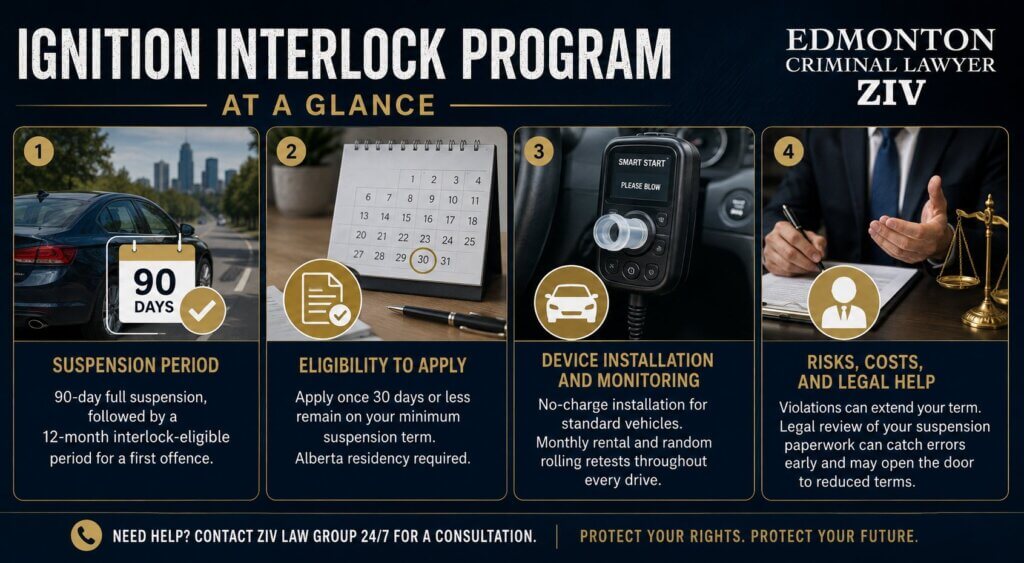
For a first offence, the typical pattern looks like this: an immediate 90-day roadside suspension, followed by an additional 12-month period during which you may drive only with an interlock device installed. If you decide not to participate in the Ignition Interlock Program at all, you stay fully suspended for the entire 15-month stretch. A second offence roughly triples that additional suspension to 36 months with an interlock, or 39 months with no driving at all if you opt out. A third offence can carry a lifetime suspension, with interlock eligibility only becoming available after the initial 90 days.
To apply, you generally need to have 30 days or less remaining on your current minimum suspension term, and you cannot be serving any other unrelated suspension at the same time. If you owe fines, are suspended for something unconnected to impaired driving, or have outstanding paperwork, your application can be denied, and having a lawyer review your Notice of Suspension before you apply catches a surprising number of these issues early.
A quick note on exemptions: there are no exemptions available under the Administrative Licence Suspension Ignition Interlock Program. If you can’t participate, financial hardship and medical conditions included, you serve the full suspension with no legal driving at all. The Mandatory Ignition Interlock Program, which follows a criminal conviction, does allow for exemption requests in narrow circumstances, but Alberta Transportation typically takes six to eight weeks to process them, so timing your application matters.
Key Takeaway
The Ignition Interlock Program is not automatic. You have to apply, meet strict timing windows, and clear your outstanding suspensions before the province will consider you. Missing the window can mean weeks of extra time with no legal driving privileges at all.
Costs, Installation, and Monitoring: What to Budget For
One thing that catches people off guard is that the Ignition Interlock Program is entirely self-funded. The province does not subsidize participation, and Smart Start Canada bills participants directly for the device and its ongoing monitoring.
| Expense | Approximate Cost | Notes |
| Ignition Interlock Program application fee | $63 | Paid at an Alberta registry agent, plus the agent’s own service fee |
| Device installation | No charge for standard passenger vehicles | Heavy trucks and specialty vehicles carry an additional surcharge of roughly $250 plus GST |
| Monthly device rental | Approximately $98 plus GST | Billed monthly for as long as the device remains in the vehicle |
| Alberta Impaired Driving Remedial Education Program (AIDREP) | Varies | Mandatory education component tied to reinstatement |
| Reinstatement fee | Varies | Paid near the end of the suspension term, separate from interlock costs |
These figures are the province’s published rates and are subject to change without notice, so I always tell clients to confirm current pricing directly with Smart Start Canada or Alberta Transportation before budgeting. What the table doesn’t show is the hidden cost of downtime: if you miss a scheduled monitoring appointment or your device needs service, you may lose driving privileges until it’s resolved, and that gap doesn’t shorten your overall suspension term.
You are also required to drive the interlock-equipped vehicle a minimum of 100 kilometres per month, or submit a written explanation to Monitoring and Compliance in advance if you can’t. Skipping this requirement without notice is treated as noncompliance, which can extend your participation term.
Pros and Cons of the Ignition Interlock Program
Deciding whether to participate isn’t automatic, even where it’s technically available. Here’s how we explain this for our clients.
| Factor | Ignition Interlock Program | Full Suspension (No Interlock) |
| Ability to drive | Restricted driving allowed almost immediately after the waiting period | No legal driving at all for the full suspension term |
| Employment impact | Can preserve a job that requires driving | Often forces job loss or unpaid leave |
| Monthly cost | Ongoing rental and monitoring fees | No device fees, but no income from driving-dependent work |
| Total time affected | Often shorter overall, since you regain mobility sooner | Longer stretch with zero driving privileges |
| Convenience | Requires regular servicing appointments and consistent use | No appointments, but no vehicle access either |
| Privacy | Breath and driving data logged and monitored by Smart Start | Not applicable |
The upside is obvious for anyone who needs a vehicle for work, childcare, or medical appointments. The Ignition Interlock Program keeps people employed and functioning while they serve out a suspension that would otherwise be a full stop. The downside is real too: monthly costs add up, missed appointments create compliance headaches, and the device itself can be inconvenient, particularly the rolling retests, which some drivers find distracting or even startling while merging in traffic.
Common Pitfalls and Mistakes to Avoid
We’ve seen the same handful of mistakes derail people’s timelines again and again. A few are worth flagging before you apply for the Ignition Interlock Program.
Checklist: Before You Apply
✔️ Confirm you have 30 days or less remaining on your current suspension before submitting your application
✔️ Clear any unrelated suspensions or outstanding fines that could cause a denial
✔️ Have a lawyer review your Notice of Suspension or Notice of Administrative Penalty for errors
✔️ Budget for the application fee, monthly rental, and any AIDREP education costs
✔️ Confirm whether your vehicle qualifies as standard or falls into the surcharge category for heavy trucks or specialty vehicles
✔️ Arrange a plan for hitting the 100 km per month driving minimum, or prepare a written explanation in advance
✔️ Book your Smart Start monitoring appointments as soon as your installation date is confirmed
Beyond the checklist, three mistakes come up constantly in my practice. First, people apply too early or too late and miss the 30-day window entirely, which delays everything. Second, people assume a financial or medical exemption is available under the Administrative Licence Suspension stream, only to find out there are no exemptions in that program at all. Third, people forget that a missed monitoring appointment or a failed rolling retest doesn’t just create an inconvenience, it can restart parts of the compliance clock and extend the time the device stays installed.
A Real-World Scenario
Consider a client we’ll call Mark, a tradesperson from the Edmonton area who was issued an Immediate Roadside Sanction after a roadside stop. His job required a truck, and losing his license for even a few weeks threatened his contract work. Mark applied for the Ignition Interlock Program the moment he became eligible, but he hadn’t realized his vehicle was registered as a specialty work truck, which triggered the additional installation surcharge he hadn’t budgeted for. He also missed his first scheduled monitoring appointment because of a job site conflict, which flagged his file for review.
Once he brought his file to our office, we helped him understand the surcharge, get his monitoring appointments rescheduled properly, and, because there were procedural issues with how his roadside sanction was documented, we were able to challenge parts of the suspension itself. His case is a good example of why the Ignition Interlock Program, while workable, isn’t something to enter without understanding the fine print.
Key Takeaway
The Ignition Interlock Program can get you back on the road faster than a full suspension, but the fine print, from calibration appointments to violation reporting, determines whether your term runs smoothly or gets extended. Legal guidance before and during the program reduces that risk considerably.
How Legal Representation Can Help Negotiate Reduced Terms
This is where experienced counsel makes the biggest difference. The Ignition Interlock Program itself has fairly fixed rules set by Alberta Transportation, but the suspension and any criminal charge behind it are not fixed at all. A lawyer’s job starts well before the interlock paperwork.
At Ziv Law Group, we look at whether the roadside stop was lawful, whether the breath testing equipment was properly calibrated and used, and whether the officer followed the procedural requirements the Criminal Code demands. Under Section 320.14 of the Criminal Code, the Crown has to prove specific elements of impaired driving or an over-the-limit reading, and gaps in that proof can lead to a withdrawn charge, a reduced charge, or a negotiated resolution that shortens the suspension period tied to the Ignition Interlock Program.
Even where a conviction is likely, a skilled DUI defence lawyer can sometimes negotiate the terms around sentencing, timing of the suspension, or eligibility for earlier interlock participation, all of which affect how soon you get back to a normal driving life. We’ve also helped clients successfully challenge procedural errors in their Notice of Suspension, which occasionally shortens the administrative side of the process even before the criminal matter is resolved.
The bottom line is that the Ignition Interlock Program is only one piece of the puzzle. What happens with your underlying charge shapes how long you’re dealing with that piece at all.
Why Contact Rory Ziv and Ziv Law Group
DUI law in Alberta moves fast, and the paperwork deadlines around the Ignition Interlock Program are unforgiving. At the Ziv Law Group, we believe that people facing impaired driving charges deserve a defence lawyer who understands both the criminal case and the administrative suspension system, because the two are tightly connected.

When you work with our Edmonton criminal defence law firm, we review your Notice of Suspension line by line, look for procedural and evidentiary weaknesses in the Crown’s case, and map out a strategy that accounts for your job, your family responsibilities, and your timeline for getting back on the road. We’ve represented clients through every stage of the Ignition Interlock Program, from initial eligibility questions to disputes over monitoring compliance, and we know the practical side of dealing with Smart Start Canada and Alberta Transportation, not just the legal theory.
If you’re facing a DUI charge in Edmonton or anywhere in Alberta, the earlier you reach out, the more options are usually on the table.
Frequently Asked Questions
How soon can I apply for the Ignition Interlock Program after a DUI suspension in Alberta?
You can apply once you have 30 days or less remaining on your minimum suspension term. Applying too early or too late can delay your eligibility, so confirming your exact suspension end date before applying is important.
How much does the Ignition Interlock Program cost per month in Alberta?
Expect roughly $98 plus GST monthly for device rental, on top of a $63 application fee. Installation is usually free for standard vehicles, though heavy trucks and specialty vehicles carry an additional surcharge.
Can I get an exemption from the Ignition Interlock Program?
No exemptions exist under the Administrative Licence Suspension stream. The Mandatory Ignition Interlock Program, tied to a criminal conviction, allows exemption requests in limited situations, with processing taking six to eight weeks.
What happens if I miss a monitoring appointment?
Missing a scheduled Smart Start monitoring appointment can flag your file for noncompliance and may extend the time the device stays installed. Rescheduling promptly and documenting the reason for the missed appointment helps limit the impact.
Can a lawyer shorten my Ignition Interlock Program requirements?
A lawyer cannot change the province’s interlock rules directly, but challenging the underlying charge or suspension can sometimes reduce the length of the suspension period tied to the program, which shortens your overall time on the device.
Ready to Talk About Your Case?
If you’re facing a DUI charge and trying to figure out what the Ignition Interlock Program means for your daily life, don’t navigate it alone. Contact Rory Ziv and the team at Ziv Law Group for a confidential consultation. We’ll walk through your charge, your suspension timeline, and the realistic options for getting you back on the road sooner, with fewer surprises along the way.