

You’re driving home, you get pulled over, and an officer asks you to blow into a small handheld device. At that moment, you might assume that refusing the test is the safer move. No breath sample means no number on a printout, right? No number means nothing to convict you with.
That logic feels intuitive. It’s also wrong, and it’s wrong in a way that catches a lot of otherwise careful, law-abiding drivers completely off guard.
In Alberta, refusing to provide a breath sample is not a clever workaround. It’s a separate criminal offence, and under the province’s Immediate Roadside Sanctions (IRS) program, it can trigger penalties that hit just as hard, and sometimes harder, than actually failing the test. At Ziv Law Group, we have represented enough clients who refused believing it would protect them to know how often that belief turns out to be the single most expensive decision of the whole encounter.
We will walk you through what a breath demand actually is, what happens when someone refuses, why the law treats refusal so seriously, and where genuine defences still exist. None of this replaces a conversation with a lawyer about your specific situation, but it should give you a realistic picture of what you’re dealing with.
What a Roadside Breath Demand Actually Means
In Canada, the legal landscape for impaired driving changed significantly in 2018 with Bill C-46. Police officers now have broad powers to demand a breath sample from any driver they have lawfully stopped. They do not necessarily need to see you swerving or smell alcohol on your breath to make this request at the roadside.
Police in Alberta have two main ways to demand a breath sample at the roadside, and the distinction matters more than most drivers realize.
The first is a reasonable suspicion demand. If an officer notices something that makes them suspect you’ve had alcohol in your system, the smell on your breath, slurred speech, an open container in the car, they can lawfully demand a sample using an approved screening device.
The second, and this surprises a lot of people, is a mandatory alcohol screening demand. Under changes to the Criminal Code, an officer who has an approved screening device on hand can demand a breath sample from a lawfully stopped driver even without any sign of impairment at all. Being pulled over for a broken taillight is enough to trigger this power. There’s no need for the officer to smell anything or notice anything unusual.
Either way, once the demand is made properly, you are legally required to comply immediately. There is no right to speak with a lawyer before blowing into a roadside screening device. That right only applies later, if you’re arrested and taken to the station for testing on an approved instrument, which produces a more precise reading that can be used as evidence in court.
A lot of confusion, and a lot of refusals, come from drivers who think they’re entitled to call a lawyer first, or who assume the roadside device isn’t reliable enough to matter yet. Neither belief holds up legally, and acting on either one can turn a routine stop into a criminal charge.
What Happens If You Refuse
Refusal doesn’t play out as a single consequence. It sets off two parallel tracks, one administrative and one criminal, and they don’t wait for each other.
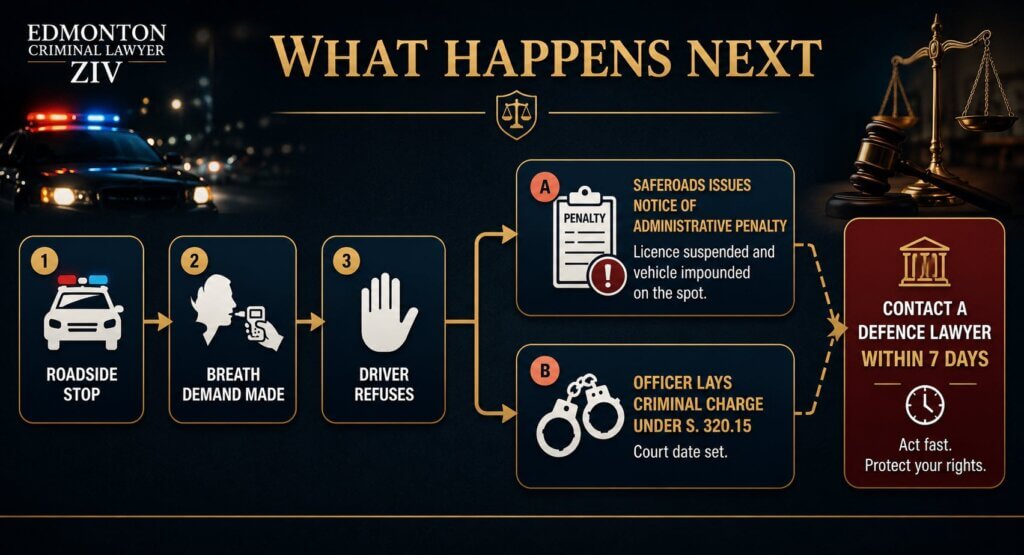
On the administrative side, Alberta’s SafeRoads program issues a Notice of Administrative Penalty right there at the roadside. Your licence is suspended immediately, typically for 90 days at minimum. Your vehicle can be seized and impounded, often for up to 30 days. You’ll also be facing a provincial monetary penalty in the range of $1,000 to $1,200, separate from anything that happens in court later.
On the criminal side, refusing a lawful breath demand is its own offence under section 320.15 of the Criminal Code. It isn’t treated as a lesser cousin of impaired driving. Parliament designed the penalties to mirror those for actually failing a breath test, precisely so that refusal can’t function as an escape hatch. You can be arrested, charged, and given a mandatory court date, and that process moves forward independently of the roadside suspension.
Here’s the part that may confuse drivers: these consequences aren’t contingent on a conviction. The licence suspension and vehicle impoundment happen on the spot, based on the officer’s belief that you refused a lawful demand. You could ultimately beat the criminal charge in court months later and still have already lost your licence and your car for weeks.
Immediate Consequences vs. Longer-Term Consequences
| Immediate (Administrative) | Longer-Term (Criminal) |
| Licence suspension begins at roadside, minimum 90 days | Mandatory court appearance |
| Vehicle impoundment, up to 30 days | Fine starting at $1,000 minimum on conviction |
| Provincial monetary penalty (roughly $1,000–$1,200) | Driving prohibition of at least one year, longer for repeat offences |
| No court hearing required before penalties apply | Criminal record if convicted |
| 7-day window to file a SafeRoads review | Mandatory jail time on second or subsequent convictions |
| Interlock program eligibility to shorten suspension | Insurance premiums often double, or policy may be cancelled |
Why Refusal Can Create Serious Legal Problems
The instinct behind refusing is understandable. People panic, or they’ve had a drink or two and genuinely aren’t sure if they’d pass, or they’ve heard secondhand that roadside devices are unreliable and figure it’s not worth the risk of a bad reading. None of that reasoning holds up once you understand how the law is actually structured.
Refusal doesn’t buy you the chance to fight the case on the accuracy of a breathalyzer reading, because there is no reading. The Crown doesn’t need to prove your blood alcohol level at all. They only need to prove that a lawful demand was made and that you didn’t comply. That’s a much narrower, and often easier, case for the Crown to build than a full impaired driving prosecution.
It also removes an entire category of defence. If you’d actually blown into the device, your lawyer could potentially challenge the machine’s calibration, the timing of the test, or whether it was administered correctly. Refuse, and those arguments simply don’t exist anymore, because there’s no test result to scrutinize.
Courts also tend to view a clear, deliberate refusal unfavourably at sentencing. Judges sometimes read it as an attempt to obstruct the investigation rather than a moment of confusion or fear, and that perception can work against you even when your actual intentions were more complicated than that.
None of this means refusal is automatically fatal to your case. It means the legal ground you’re standing on shifts, and the defences available become narrower and more procedural in nature. That’s exactly where an experienced lawyer’s review of the file starts to matter.
Common Reasons People Refuse (and Why They Usually Backfire)
- They think no sample means no evidence. In reality, the refusal itself becomes the evidence.
- They believe they’re entitled to a lawyer before blowing. At the roadside stage, that right doesn’t exist yet.
- They panic and freeze, and the officer interprets hesitation or repeated failed attempts as refusal, even without a clear verbal “no.”
- They have a genuine medical condition, like severe asthma or a respiratory illness, but don’t say anything to the officer at the time, which makes the medical explanation much harder to establish later.
- They assume the device is inaccurate and decide it isn’t worth cooperating, without realizing accuracy challenges only become available if a sample is actually provided.
Possible Defences
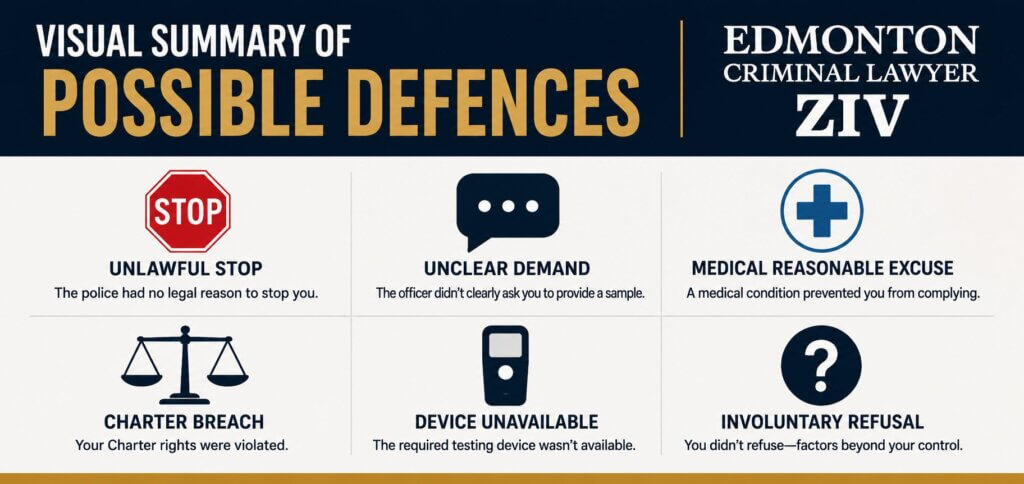
Refusal charges are hard to fight, but they are not automatically unwinnable. The defences that do succeed tend to turn on procedure, communication, and physical or medical reality, rather than on disputing that a refusal happened.
| Defence | What It Challenges |
| Unlawful stop or demand | Whether the officer had valid legal grounds to stop you or demand a sample in the first place |
| Improper demand or unclear instructions | Whether you actually understood what was being asked of you, including language barriers |
| Reasonable excuse (medical) | Whether a genuine physical or medical condition made it impossible to provide a sample |
| Charter breaches | Whether your rights were violated during the stop, arrest, or subsequent detention |
| No approved device on hand | Whether the officer actually had a functioning, approved screening device available at the time of the demand |
| Involuntary or not truly a refusal | Whether repeated genuine attempts to comply were mischaracterized as a refusal |
A reasonable excuse defence, for example, requires more than just saying you were anxious. Courts want to see that the condition was real, that it genuinely prevented compliance, and ideally that it was communicated to police at the time, not invented afterward. A Charter argument might focus on whether the officer had legitimate grounds for the traffic stop itself, since an unlawful stop can undermine everything that follows from it, including the demand.
How a Lawyer Reviews These Cases
When you bring an IRS notice to the Ziv Law Group, we do not start from the assumption that the client made the wrong call. We move quickly because the timelines are incredibly short. We review the government’s disclosure (the evidence against you) to find inconsistencies because we start from the assumption that the Crown still has to prove every element of the offence, and that the file might contain gaps they haven’t accounted for.
That review typically includes:
- The officer’s notes and disclosure, checked line by line against what actually happened, since inconsistencies between the notes and any video or audio can open up cross-examination opportunities.
- Body-worn or dash camera footage, where available, to see exactly how the demand was worded and how the driver responded.
- The timeline of the stop, to confirm the demand was made without unreasonable delay and that the driver had a fair opportunity to comply.
- Whether the screening device was approved, calibrated, and actually present at the time the demand was made, not assumed or logged after the fact.
- Any medical records or contemporaneous statements that support a reasonable excuse argument.
- The legality of the initial stop, particularly for mandatory alcohol screening demands, where the constitutional footing is still being tested in some cases across the country.
Some of these threads lead nowhere. Others turn into the basis of a real defence, or at minimum, a stronger position for negotiating a reduced charge. You won’t know which until someone experienced actually goes through the file.
What To Do Next If This Happened to You
If you’ve just been through a roadside refusal, or you’re facing a Notice of Administrative Penalty and a criminal charge, the next week matters more than people realize.
- Note the seven-day clock. SafeRoads reviews of the administrative suspension need to be filed within seven days of the notice. Miss that window, and you lose the chance to challenge the roadside penalty separately from the criminal case.
- Write down what you remember while it’s fresh. The exact wording used by the officer, how you felt physically, anything you said or tried to say. Memory fades fast, and small details can matter later.
- Don’t discuss the incident on social media or with anyone other than your lawyer. It’s a small thing people overlook, but it can complicate a defence.
- Get legal advice before your first court date, not the day of. There’s often more that can be done before the case reaches court than most people assume, including negotiating disclosure requests and reviewing whether the charge itself holds up.
Why Early Legal Advice Matters
The seven-day SafeRoads review window is the clearest reason to move quickly, but it’s not the only one. Evidence has a shelf life. Dash camera footage gets overwritten on a schedule. Officer memory, like yours, fades. The earlier a lawyer can request and preserve disclosure, the more complete a picture they can build of what actually happened.
There’s also a practical, human reason. A refusal charge sits over your head for months before it resolves, affecting insurance, employment questions, and just general peace of mind. Getting a clear, honest assessment of where your case actually stands, not what you’ve read on a forum somewhere, tends to reduce that weight considerably, even before the legal outcome is known.
Frequently Asked Questions
What counts as a “refusal”?
It isn’t just saying “no.” It can also include pretending to blow into the device or not providing enough breath to get a reading.
Is refusing worse than failing a breath test?
In many respects, yes. Failing at least gives your lawyer a number to scrutinize, the device’s calibration, timing, and procedure. Refusal removes that evidence entirely, which narrows your defence options and can be read by a judge as deliberate non-cooperation.
Do I have the right to call a lawyer before blowing into the roadside device?
No. That right applies once you’re arrested and taken for testing on an approved instrument at the station, not at the initial roadside screening stage.
What counts as a reasonable excuse for refusing?
Genuine medical conditions, such as a severe respiratory illness that physically prevents you from providing a sufficient breath sample, can sometimes qualify. Fear, confusion, or a mistaken belief about your legal rights generally do not.
How long will my licence be suspended if I refuse?
Under Alberta’s Immediate Roadside Sanctions program, a refusal typically triggers a minimum 90-day suspension, separate from and in addition to any penalty that follows a criminal conviction.
How much time do I have to challenge the suspension?
You generally have seven days from the Notice of Administrative Penalty to file a SafeRoads review. This deadline is strict, so it’s worth acting quickly.
Can a refusal charge be beaten in court?
It’s possible, particularly where the stop or demand had procedural or constitutional problems, or where a genuine reasonable excuse applies. It isn’t automatic, and outcomes depend heavily on the specific facts of the stop.
Should I just comply next time instead of refusing?
For most drivers, yes. Complying preserves more defence options down the road than refusing does, and refusal rarely spares you from consequences the way people hope it will.
Can I get a “hardship” license for work?
No. Alberta does not offer restricted licenses for work purposes during the initial suspension period. You must serve the 90 days before you can even apply for the interlock program.
Will my insurance find out about a refusal?
Yes. A refusal conviction or an upheld IRS sanction will cause your insurance rates to skyrocket, sometimes by as much as 400 per cent.
Does this apply to electric scooters or mopeds?
Yes. In Alberta, you can be charged for operating almost any motorized conveyance while impaired or for refusing a demand, including e-scooters.
What to Expect From Here
At the Ziv Law Group, we are always upfront with our clients and explain to them that there’s no guaranteed outcome here, and any lawyer who promises you one before reviewing your file isn’t being totally forthcoming with you. Some refusal cases resolve with the charge withdrawn after disclosure reveals a procedural gap. Others resolve with a negotiated plea to a lesser charge. Some go to trial. Which path fits your case depends entirely on the specifics, the stop, the demand, the device, your circumstances that day.
What we can tell you is that doing nothing, or waiting until your first court date to think seriously about it, closes doors that were open in week one. If you’re facing this right now, the smartest thing you can do is talk to someone who handles these cases regularly, before the SafeRoads window closes and before memories and footage start to fade.

If you’ve received an IRS notice for refusing a breath test, contact Rory Ziv and the Ziv Law Group online or call us toll-free 24/7 at 1 (833) 429-4004. You can also text or email a photo of your notice to get your appeal started immediately. We’ll walk through what happened, look honestly at where your case stands, and talk through what your realistic options actually are, no pressure, no guarantees, just a clear evaluation of your situation from someone who’s been through this process many times before.
This article is intended as general information about Alberta’s impaired driving and refusal laws. It is not legal advice, and it isn’t a substitute for a lawyer’s review of your specific circumstances. Laws and procedures can change, and outcomes depend on the individual facts of each case. If you’re facing a breath test refusal charge, speak with a criminal defence lawyer as soon as possible.