
For many Canadians, drugs are a regular part of our everyday lives. Many Canadians are routinely prescribed pharmaceuticals and have legally purchased and consumed recreational cannabis.
With that said, the Controlled Drugs and Substances Act prohibits the possession, use or control of certain drugs. These drugs and substances are separated into 5 different categories known as “schedules”. The seriousness of the offence is largely influenced by which schedule the drug has been categorized into. Some of the substances are “banned” completely, while others can be possessed under limited conditions, such as if it was prescribed by a doctor.
Common examples include:
Possession under section 4 of the Controlled Drugs and Substances Act is not just about what was found. The Crown has to prove knowledge and control, meaning you knew the substance was there and had some degree of power over it. This matters enormously in shared vehicles, shared apartments, and situations where a substance is found in a backpack or glove compartment that more than one person had access to. Trafficking, possession for the purpose of trafficking, and production each carry their own distinct legal test, and the label police put on a charge at the time of arrest is often broader than what the evidence will actually support once disclosure comes in.
Offence | Schedule I / II (e.g. fentanyl, cocaine, meth) | Schedule III (e.g. LSD, psilocybin) | Schedule IV (e.g. benzodiazepines, steroids) |
Simple possession (s. 4) | Up to 7 years indictable | Up to 3 years indictable | Up to 18 months indictable |
Trafficking / possession for the purpose of trafficking (s. 5) | Up to life imprisonment | Up to 10 years indictable, 18 months summary | Up to 3 years indictable, 1 year summary |
Production (s. 7) | Up to life imprisonment | Up to 10 years indictable | Up to 3 years indictable |
Import / export (s. 6) | Up to life imprisonment | Up to life imprisonment (schedule-dependent) | Up to life imprisonment (schedule-dependent) |
These are statutory ceilings, not predictions. A first-time possession charge involving a small personal amount almost never results in anything close to the maximum, and Bill C-5, which received royal assent in November 2022, eliminated every mandatory minimum sentence that used to exist under the CDSA. That change followed the Supreme Court’s 2016 decision in R v Lloyd, which struck down a one-year mandatory minimum for trafficking as cruel and unusual punishment under section 12 of the Charter after the Court noted it could apply to someone sharing a small amount of a drug with a friend. Judges now have far more discretion than they did a decade ago, which is exactly why the specific facts of your file, not just the charge on the paper, drive the outcome.
Most drug prosecutions start with a search: a traffic stop, a residence search under warrant, or a search connected to an arrest for something unrelated. Section 8 of the Charter protects against unreasonable search and seizure, and a meaningful share of drug defence work involves testing whether police had proper grounds before they searched a vehicle, a phone, or a home. If a search was unlawful, the evidence found during it can potentially be excluded under section 24(2) of the Charter, and without that evidence, many Crown files simply cannot proceed. This is not a technicality clients should dismiss. It is often the single strongest lever available in a possession or trafficking file, and it requires a lawyer who reviews the search warrant, the officer’s notes, and the timeline closely rather than accepting the police narrative at face value.
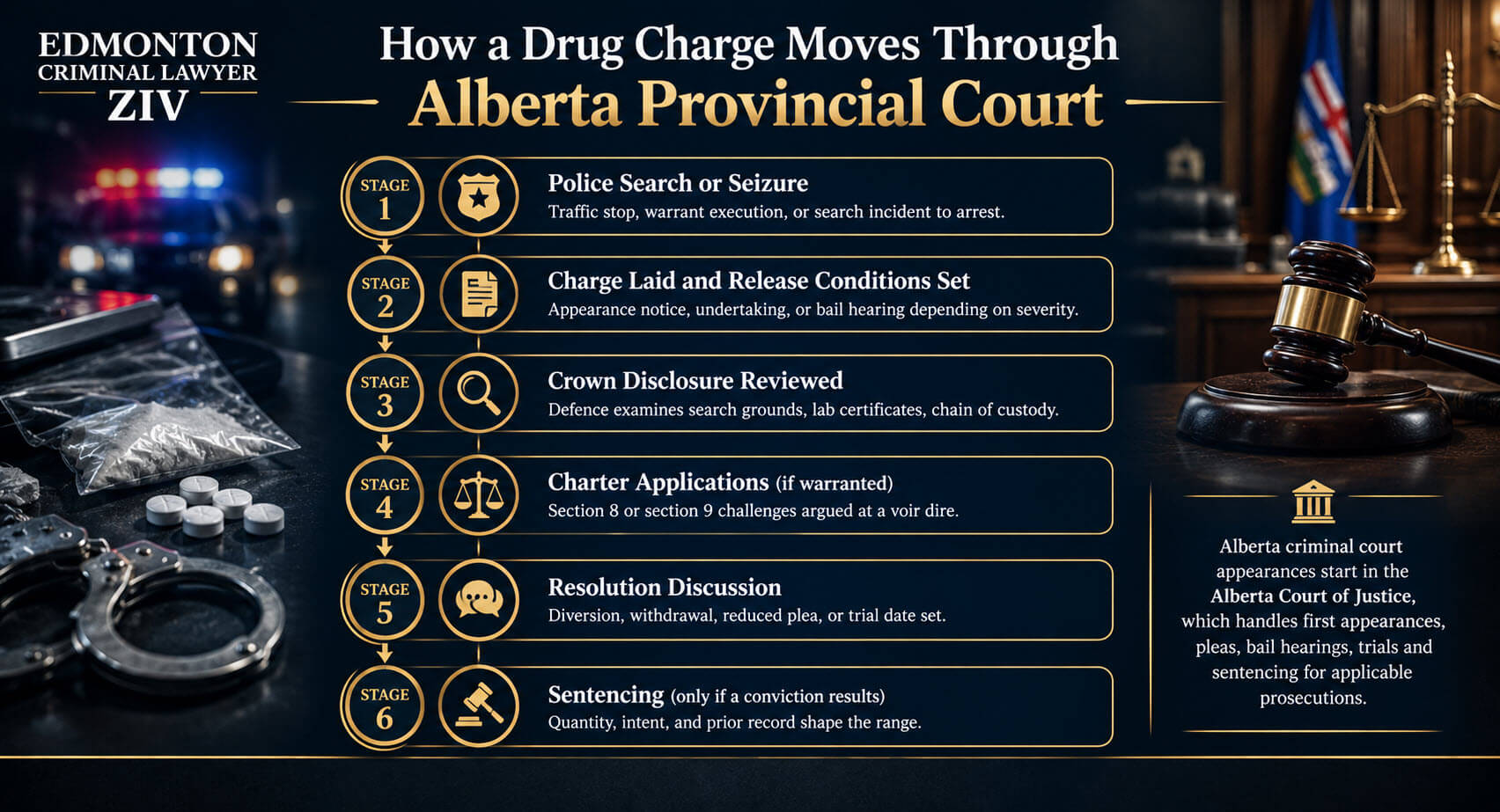
Beyond removing mandatory minimums, Bill C-5 also directed police and prosecutors to consider referring people to treatment or other support services rather than laying charges for simple drug possession in the first place, and it expanded when a judge can impose a conditional sentence (served in the community rather than in custody) instead of jail. In practice, this means a first-time possession file with no aggravating features has more off-ramps available today than it did five years ago. Conditional discharges, which leave no conviction on your record once the probation period ends, remain a realistic outcome in the right circumstances, particularly where addiction is a documented factor rather than something raised for the first time at sentencing.
Path | Record Result | Typical Fit |
Charges withdrawn | None | Charter breach found, or evidentiary gap in the Crown’s file |
Diversion or treatment referral | None if completed | First offence, small quantity, documented substance use issue |
Conditional discharge | None after probation | Guilty plea, lower-end facts, limited or no record |
Guilty plea to reduced charge | Yes, but often summary rather than indictable | Weighing exposure against trial risk |
Trial | Depends on verdict | Strong Charter argument or genuine dispute over knowledge and control |
A drug conviction, even a relatively minor one, tends to follow people well past their court date. Non-citizens face immigration consequences that can include inadmissibility to Canada, and drug offences are treated with particular severity at the United States border, where even an old, minor conviction can trigger a lifetime entry ban that a pardon in Canada will not fix. Professional licensing bodies, from nursing to law to the trades, often ask about criminal records directly, and a production or trafficking conviction can affect employment in regulated industries for years. These downstream effects are usually a bigger part of the conversation with clients than the immediate penalty, and they are part of why an early, well-argued resolution matters more than simply waiting to see what the Crown offers.
Ziv Law Group handles drug possession, trafficking, production, and importation files in Edmonton and at surrounding courthouses including St. Albert, Sherwood Park, and Leduc. Because so much of a drug defence turns on how a search was conducted, the firm’s approach starts with a close read of the disclosure package: the warrant application, the officer’s grounds, the lab certificate, and the chain of custody, before any conversation about plea or trial. Consultations are confidential and available 24/7.
Generally no, though exceptions exist for searches incident to arrest or exigent circumstances. An unlawful search can support a Charter application to exclude the evidence, which is often the strongest defence available in possession and trafficking files.
Not necessarily. Since Bill C-5 took effect in 2022, diversion, treatment referrals, and conditional discharges are realistic outcomes for a first offence involving a small quantity, particularly with no aggravating factors present.
Trafficking covers actually selling, delivering, or offering a substance. Possession for the purpose of trafficking applies when someone holds a quantity, packaging, or other evidence suggesting intent to sell, even without a completed transaction.
US border officials can deny entry, sometimes permanently, based on a drug conviction or even an admission of past drug use, regardless of a Canadian pardon or record suspension. This makes early legal strategy particularly important for anyone who travels for work.
Yes. Quantity affects sentencing, not whether a charge can be laid, and small-amount files still turn on search legality, chain of custody, and whether the Crown can prove knowledge and control beyond a reasonable doubt.
Whether it’s possession, trafficking, or production, a drug conviction can impact your freedom, career, and immigration status. We’ll help you understand your legal options and build a strong, strategic defence. Book your confidential consultation today.