

Facing a drug possession charge can be one of the most stressful moments of your life. In Alberta, the legal system treats controlled substances with significant gravity, and the repercussions of a conviction extend far beyond a simple fine. Whether you were found with a small amount of a substance for personal use or are caught in the web of a larger investigation, your future depends on the steps you take immediately following an arrest.
At Ziv Law Group, we understand that for many, drugs are an everyday reality, from legal cannabis to prescribed pharmaceuticals. However, the Controlled Drugs and Substances Act (CDSA) creates strict boundaries regarding what you can possess, use, or control. If you find yourself on the wrong side of these boundaries, you need an advocate who views your case personally. Rory Ziv, a highly qualified Edmonton criminal lawyer, is dedicated to fighting for truth and justice for those caught in the complex machinery of the criminal justice system.
Understanding the Legal Landscape of Drug Offences
The CDSA is the primary federal legislation governing drug offences in Canada. It does not treat all substances equally; instead, it organizes them into “schedules” based on their perceived danger and potential for abuse.
The Classification of Substances (Schedules)
The severity of your charge is heavily influenced by which schedule the substance falls into:
- Schedule I: This includes what the courts view as the most serious drugs, such as cocaine, methamphetamine, amphetamines, and opium.
- Schedule II: Currently focuses on synthetic cannabis.
- Schedule III: Includes substances like LSD and psilocybin (magic mushrooms).
- Schedule IV: Encompasses anabolic steroids and barbiturates.
- Schedule VI: Relates to precursor chemicals used in drug manufacturing.
What Actually Constitutes “Possession”?
Many people are surprised to learn that “possession” in a legal sense is broader than just having something in your pocket. Under Section 4(1) of the CDSA, you can be charged for various forms of control over a substance.
The legal definition is much broader and can include several scenarios. Authorities can charge you with possession if you have physical custody of a controlled substance, if you’re aware of drugs in your immediate vicinity and have control over them, or if drugs are found in a location you control, such as your home or vehicle, and you knew about their presence.
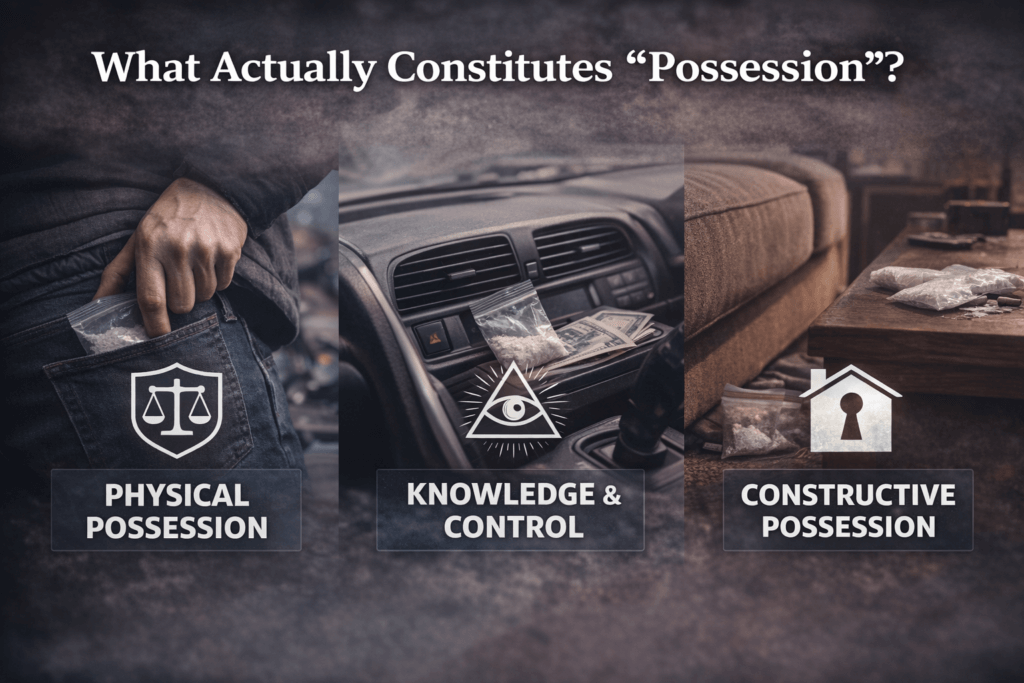
The Crown prosecutor must prove three essential elements beyond a reasonable doubt to secure a conviction. First, they must demonstrate that you had physical possession, custody, or control of the substance. Second, they must show that you had knowledge of the drug’s presence. Finally, they must prove that the substance in question is indeed a controlled substance listed in the CDSA schedules.
This means you could potentially be charged with “constructive possession” even if drugs were never physically on you. For example, if illegal substances were discovered in your apartment and the Crown can prove you were aware of their presence and had some degree of control over them, you could face possession charges. Similarly, “joint possession” can occur if you’re in a vehicle where drugs are found, and it can be shown that you knew about them and consented to their presence.
Potential Penalties for Drug Possession in Alberta
Understanding the penalties you may face is essential when charged with drug possession in Alberta. The consequences can range from relatively minor fines to significant prison time, depending on the type of drug, the amount in your possession, your criminal history, and how the Crown chooses to proceed with the charges.
First-Time Offenders
For individuals facing their first drug possession charge, penalties vary considerably based on the substance involved and the circumstances of the offence. Simple possession of small quantities may result in fines ranging from $1,000 to $2,000, probation with conditions such as mandatory counselling or community service, or imprisonment for up to six months for summary conviction offences. However, if the Crown proceeds by indictment, maximum penalties increase substantially – up to three years for some substances and seven years for drugs like cocaine and heroin.
Many first-time offenders may be eligible for diversion programs, which allow individuals to avoid a criminal conviction by completing specific requirements such as drug education courses, community service, or treatment programs. Successfully completing a diversion program can result in charges being withdrawn.
Repeat Offenders and Aggravating Factors
The consequences become more severe for repeat offenders. Second convictions typically carry doubled penalties, and courts take prior drug-related offences very seriously when determining sentences. Certain aggravating factors can also increase penalties significantly, including possession near schools or areas frequented by minors, involvement in organized crime, use of weapons, evidence suggesting trafficking intent, such as scales or packaging materials, and possession of large quantities of drugs.
The Immediate Aftermath: Arrest and Your Rights
If you are stopped by police, you have fundamental rights protected by the Canadian Charter of Rights and Freedoms.
Your Right to Silence and Counsel
In Canada, you have the right to be informed immediately of the reason for your arrest. Police must also inform you of your right to a lawyer and provide you with access to a telephone to contact one as soon as possible.
It is a common misconception, often fueled by American television, that police must stop questioning you if you choose to remain silent. In Canada, the police can continue to interrogate you even if you state you do not wish to speak. While you are generally not obligated to provide information – other than identifying details like your name and address if you are under arrest – it is vital to remember that lying to the police is a criminal offence.
Search and Seizure
Drug charges frequently arise from police searches, such as a “pat-down” during an arrest or a vehicle search. While law enforcement has certain powers to search without a warrant, these powers are limited. If the police infringed upon your Charter rights during a search, Rory Ziv can argue for an appropriate remedy, which may include having the evidence excluded and the charges dismissed.
How the Prosecution Proceeds: Summary vs. Indictment
The Crown Prosecutor has the discretion to choose how to move forward with your case, a process known as a “Crown Election”.
- Summary Conviction: These are handled by a Provincial Court Judge and are generally for less serious instances of the offence, attracting lower penalties.
- Indictable Offences: These are reserved for more serious cases and carry much harsher punishments, including longer prison sentences.
The True Cost of a Drug Conviction in Alberta
A conviction for drug possession is not just a mark on your record; it is a barrier to your future.
Employment and Professional Life
Many employers, particularly those requiring security clearances or positions of trust, conduct background checks. A drug conviction can make it nearly impossible to obtain or keep a job in many sectors.
International Travel Restrictions
A criminal record for drug possession can lead to being barred from entering certain countries. This includes common vacation destinations like the United States and Mexico.
Immigration Consequences
If you are not a Canadian citizen, the impact of a drug conviction can be devastating. It may lead to severe immigration challenges, including the risk of being deported or denied permanent residency.
Common Defences to Drug Possession Charges
Not every drug possession charge leads to a conviction, and there are several strong legal defences that may apply to your situation. An experienced criminal defence lawyer will carefully examine every aspect of your case to identify weaknesses in the Crown’s evidence and violations of your constitutional rights that could result in charges being dismissed or reduced.

Charter Rights Violations
One of the most effective defences against drug possession charges involves challenging how police obtained evidence. The Canadian Charter of Rights and Freedoms protects citizens against unreasonable search and seizure (Section 8), arbitrary detention (Section 9), and guarantees the right to counsel upon arrest (Section 10).
If police conducted an illegal search, such as searching your vehicle or home without a warrant, proper grounds, or your informed consent, any evidence obtained during that search may be excluded from trial. Similarly, if you were arbitrarily detained without reasonable grounds, or if police failed to properly inform you of your right to counsel, these Charter violations could result in evidence being deemed inadmissible.
An experienced criminal defence lawyer will meticulously review every aspect of your arrest and the investigation to identify potential Charter breaches that could lead to evidence exclusion or case dismissal.
Lack of Knowledge or Control
Remember that possession requires both knowledge and control. If you were genuinely unaware that drugs were present, for instance, if someone left drugs in your vehicle without your knowledge, you may have a valid defence. Similarly, if you lacked control over the drugs, such as being a passenger in someone else’s vehicle where drugs were found, this could negate the possession charge.
These defences require careful presentation of evidence and credible testimony. Your lawyer will work to demonstrate that the Crown cannot prove beyond a reasonable doubt that you had the requisite knowledge and control.
Lack of Possession
The Crown must prove that you actually possessed the drugs. If the substances were found in a shared space, your lawyer might argue that they could have belonged to anyone with access to that location. The burden is on the prosecution to prove your possession specifically, and creating reasonable doubt about this element can lead to acquittal.
Illegal Substances Not Proven
The Crown must provide laboratory analysis proving that the substance seized is indeed a controlled substance under the CDSA. If there are issues with the analysis, chain of custody problems, or delays in testing, your lawyer may challenge whether the Crown has adequately proven the substance’s nature. Any break in the chain of custody or mishandling of evidence can create reasonable doubt.
Entrapment
In cases involving undercover operations or police informants, entrapment may be a defence if police improperly induced you to commit an offence you would not have otherwise committed. While this defence is rare and difficult to prove, if police went beyond providing an opportunity to commit a crime and instead actively coerced or manipulated you into possession, entrapment arguments may succeed.
How Rory Ziv Can Defend You
Facing the state alone is intimidating. Rory Ziv brings extensive experience to the table, having handled some of the most complex drug and serious crime cases in Alberta.
Strategic Defence Planning
Mr Ziv meticulously assesses the Crown’s case to find weaknesses. This includes:
- Challenging the legality of searches and seizures.
- Scrutinising the evidence for “possession” or “intent”.
- Navigating the complexities of Bail Hearings, especially in “Reverse Onus” situations where the accused must prove why they should be released.
His goal is always to achieve the best possible result, whether that is a full acquittal at trial, a withdrawal of the charges by the Crown, or a reduction in sentencing.
Contact Edmonton Criminal Defence Lawyer Rory Ziv Today
Your reputation, your freedom, and your ability to travel are all on the line. Don’t leave your future to chance. Rory Ziv and the Ziv Law Group provide the rigorous, personalized defence you need when facing drug charges in Alberta.

We recommend an initial consultation to discuss your situation and assess the risks and benefits of your legal options.
Take the first step toward protecting your future and call Rory Ziv toll-free at 833-429-4004 or contact us online to schedule your confidential consultation. Our team is available 24/7 because your rights don’t take a day off.
Frequently Asked Questions About Drug Possession
What should I do if the police find drugs in my car?
Do not resist or interfere with the police, but do not provide a statement without legal counsel. Contact Rory Ziv immediately. We will investigate if the search was lawful and if the drugs can truly be linked to you legally.
Can I go to jail for a first-time drug possession charge?
While first-time offenders may have more options, jail is a possible sentence under the CDSA. Factors like the type of drug (Schedule I vs. Schedule III) and the amount found play a major role in sentencing.
Is it legal to record my arrest on my phone?
Yes, there is no law in Canada that stops you from filming police in a public space. However, you must ensure you are not interfering with their duties or obstructing the arrest, as that could lead to further charges.
What if I was holding the drugs for a friend?
Legally, this is still considered possession. If you have control over the substance, the law considers you to be in possession of it, even if you do not own it.
Can drug charges be resolved without a trial?
In some cases, yes. Rory Ziv can negotiate with the Crown for a withdrawal of charges or a more lenient resolution, such as a Peace Bond or a discharge, depending on the circumstances of your case.