

If you have just been charged, or you think charges are coming, the first hours matter more than most people realize. A domestic violence lawyer in Edmonton can tell you within a single phone call what conditions you are likely facing, whether a bail hearing is probable, and what your realistic options look like. Ziv Law Group has spent years defending these cases in Provincial Court locations across Alberta, and this page walks through how the process actually works, not the version of it you see on television.
Domestic violence allegations move faster and harder than most other criminal files. Police in Alberta lay charges in the large majority of cases where a domestic complaint is made, regardless of whether the person who called wants that outcome. Crown prosecutors then apply a “special prosecutions” mindset to these files, meaning withdrawal is harder to negotiate than in a typical assault matter between strangers. None of that means your case is unwinnable. It means you need someone who has actually sat across from these prosecutors before.

Here is something that surprises a lot of clients: there is no charge called “domestic violence” anywhere in the Criminal Code. What exists instead is a set of ordinary criminal charges, assault, uttering threats, criminal harassment, and so on, where the relationship between the accused and the complainant becomes a factor the court weighs at sentencing. Under section 718.2(a)(ii) of the Code, evidence that an offence involved abuse of a spouse, common-law partner, or family member is treated as an aggravating circumstance, meaning it tends to push sentences upward compared to the same act committed against a stranger.
“Intimate partner” was formally defined in the Code in 2019 to include current and former spouses, common-law partners, and dating partners, regardless of whether the couple ever lived together. Family violence, a related but separate concept, generally refers to abuse involving children or other relatives rather than a romantic partner. Both fall under the same umbrella of charges below.
Charge | Criminal Code Section | Crown Election | Notes |
Common assault | Hybrid | Includes pushing, grabbing, or threatening gestures; no injury required | |
Assault causing bodily harm | Hybrid | Any injury beyond trifling or transient counts | |
Aggravated assault | Indictable | Wounding, maiming, or endangering life | |
Uttering threats | Hybrid | Words alone can support this charge | |
Criminal harassment | Hybrid | Repeated contact that causes the other person to fear for their safety | |
Unlawful confinement | Indictable | Preventing someone from leaving a room or the home | |
Breach of undertaking or release order | Hybrid | A new, separate charge for violating bail or release conditions | |
Mischief | Hybrid | Damaging shared or a partner’s property during a dispute |
A hybrid offence lets the Crown choose to proceed summarily (lower maximum penalty, faster process) or by indictment (higher maximum penalty, more procedural steps). That decision is made case by case and it shapes almost everything that follows, including whether you have the right to elect trial by judge and jury.
Police attending a domestic call in Edmonton decide whether to lay a charge, not the person who called 911 and not the person accused. If you are not arrested on the spot, you may instead receive an Appearance Notice or Promise to Appear listing a court date. If you are taken into custody, you will typically be released on an Undertaking with conditions attached, or, if the file is more serious or you have a prior record, held for a bail hearing before a Justice.
Bail in intimate partner violence cases has gotten stricter in recent years. Following amendments made through Bill C-48 in December 2023, an accused with a prior conviction or discharge for violence against an intimate partner now faces a reverse onus at bail under section 515(6)(b.1), meaning the defence, not the Crown, must convince the court that release is appropriate. This is one of the areas where having a lawyer involved at the bail stage, rather than after the fact, changes outcomes.
Almost every release comes with a no-contact condition covering the complainant and often other family members or witnesses. Some orders bar you from the family home entirely, sometimes with a single police-supervised visit allowed to collect essential belongings. You may also be directed to attend a police station for fingerprints and photographs; skipping that step typically results in an additional charge.
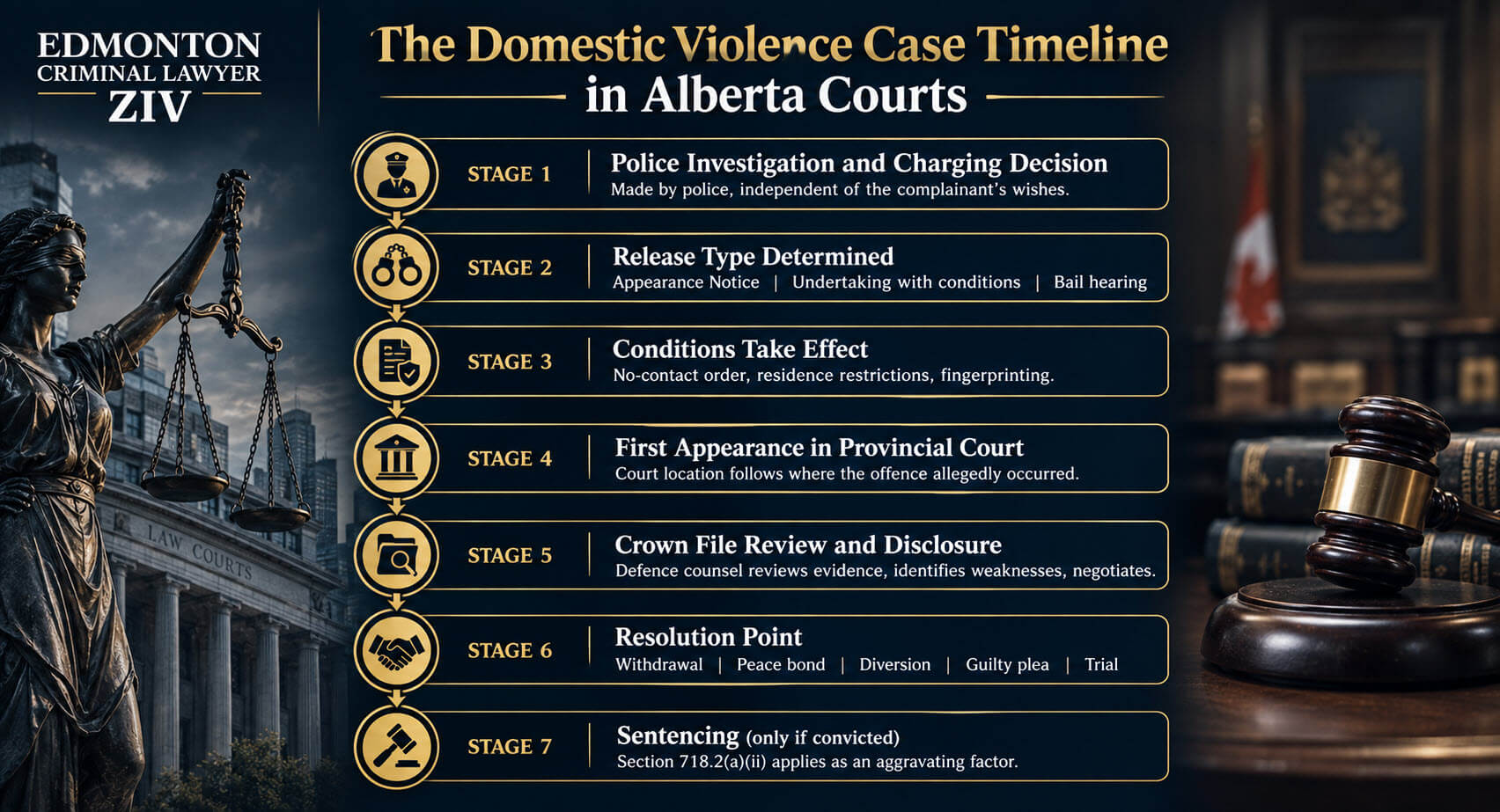
One detail that trips people up: your court date is tied to where the alleged offence happened, not where you live. Someone charged after an incident in Wetaskiwin, St. Albert, or Leduc will usually need to appear at that local courthouse even if their home address is in Edmonton.
A blanket no-contact order can separate you from children, a shared bank account, and a home you are still paying for. Courts will sometimes agree to vary these conditions, allowing supervised contact, written communication about parenting, or removal of the home-exclusion clause, but the request has to be argued formally in front of a judge, usually with the Crown’s position on record. This is rarely something worth attempting without a lawyer preparing the submissions, since a poorly framed request can end up reinforcing the existing order rather than loosening it.
Clients often ask whether things end once the other person says they no longer want to proceed. They do not. Once police lay a charge, only the Crown Prosecutor’s office has authority to withdraw it. A complainant can send a letter, speak to the Crown directly, or file what is sometimes called a recantation, and that input carries real weight in the Crown’s decision-making, but it does not bind the prosecutor. Some files proceed even over a complainant’s stated objection, particularly where there is independent evidence like injuries, 911 recordings, or witness statements.
A peace bond is a court order requiring someone to “keep the peace and be of good behaviour,” usually for six to twelve months, in exchange for the Crown withdrawing the underlying charge. No guilt is admitted and no conviction is registered. Alberta courts generally recognize two versions: a section 810 peace bond under the Criminal Code, which requires evidence supporting a reasonable fear on the complainant’s part, and a common law peace bond, negotiated directly between defence and Crown counsel as part of resolving a file. Both require the Crown’s consent, and neither is automatic.
Outcome | Criminal Record? | What Is Required |
Charges withdrawn | No | Crown concludes there is no reasonable prospect of conviction or that proceeding is not in the public interest |
Peace bond | No | Crown consent, agreed conditions, no admission of guilt |
Diversion or alternative measures | Usually not | Crown discretion, often limited to first-time, lower-severity files |
Guilty plea | Yes | Formal admission, sentencing follows under s. 718 principles |
Trial acquittal | No | Crown fails to prove the charge beyond a reasonable doubt |
Trial conviction | Yes | Judge or jury finds guilt proven beyond a reasonable doubt |
A conviction on a domestic-related charge, even a first offence with no injury, produces a permanent criminal record unless a discharge is granted. That record can block entry to the United States, complicate a Mexican vacation, limit certain jobs (particularly ones requiring a vulnerable sector check), and create separate, often severe, consequences for anyone who is not a Canadian citizen. Probation frequently carries its own no-contact terms, which can keep a family apart well past the original court date. Given how the reverse onus and sentencing rules described above have tightened in recent years, waiting to see what happens rarely works in your favour.
Rory Ziv and the team at Ziv Law Group handle domestic violence files across the Edmonton region and in surrounding courthouses including St. Albert, Sherwood Park, Leduc, and Wetaskiwin. The firm’s approach starts with an honest read of the file: what the disclosure actually shows, where the Crown’s evidence is thin, and whether a peace bond, a reduced charge, or a full trial gives you the best realistic outcome. Consultations are available 24/7, which matters in a practice area where the first conditions imposed on you are often set within hours of an arrest.
Yes. Police, not the complainant, decide whether to lay a charge in Alberta, and Crown prosecutors decide whether to continue it. A complainant’s wishes can influence that decision but never control it on their own.
Any contact, even a text initiated by the other person, can result in a separate breach charge under section 145. Breach charges are common, taken seriously by the Crown, and can affect your eligibility for future bail.
It can. Family court often considers pending criminal charges when deciding parenting arrangements, and a no-contact condition tied to your criminal release may itself restrict contact with children in the home. Early legal advice helps limit that overlap.
No. A peace bond involves no admission of guilt and results in no criminal conviction, though it does require agreeing to specific conditions for a set period. The Crown must consent, and it typically comes with withdrawal of the original charge.
Avoid all contact with the complainant, follow every condition exactly as written, keep any paperwork police gave you (it lists your court date and location), and call a lawyer before speaking to police or the Crown about the incident.
Domestic-related charges can feel overwhelming, especially when your family, home, or future is at stake. We’ll help you understand your rights, address no-contact orders, and build a legal strategy that considers both the law and your life.